Air Fryer Banana
Temperature
400°F
200°C
Time
8 min
2 bananas, halved lengthwise (serves 2)
Heat through to
Piping hot
cooked right through
Prep
5 min
Cook
8 min
Total
13 min
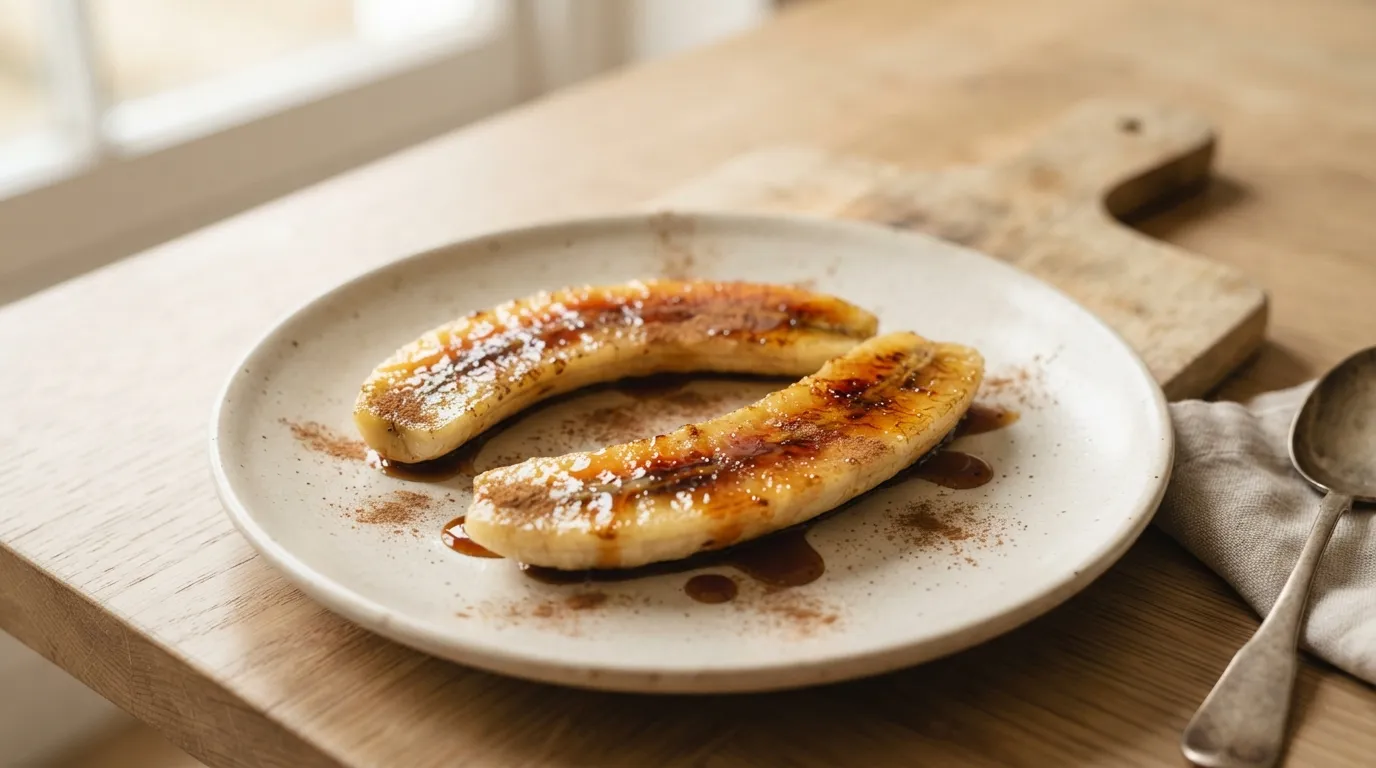
Two bananas, split down their length, take about 8 minutes at 400°F (200°C) - buttered and sugared before they go in, cut side up, and never turned. There is no safe temperature to reach here, because a banana is edible raw: the whole cook is about the sugar on the cut face rather than about the fruit underneath it.
Ingredients
Quantities for 2 bananas, halved lengthwise (serves 2) - the times on this page assume that much in the basket.
- 2 firm, just-ripe bananas (yellow, a spot or two, no soft patches)
- 2 tsp butter, melted
- 2 tbsp light brown sugar
- 1/4 tsp ground cinnamon
How to air fry banana
- Peel the bananas and split each one down its length, then lay the halves cut side up and brush the cut faces with the melted butter. Stir the sugar and cinnamon together, scatter it over the buttered faces, and get them into the basket straight away rather than leaving them standing - sugar on cut fruit starts pulling the juice out of it.
- Preheat the air fryer to 400°F (200°C).
- Add the fresh banana to the basket. Four halves fit a standard basket in a single layer, cut side up, with a gap between them. Cut side up is not presentation - a sugared face laid against the basket floor is the one arrangement here that will not come off in one piece. Halves left touching weld together along the join as the syrup thickens and tear when you pull them apart. A perforated liner catches what runs off, which would otherwise bake onto the drawer.
- Cook for about 8 minutes.
Pro tip
Sugar them at the last moment rather than while the fryer preheats. Sugar sitting on a cut surface pulls water out of the fruit - the same effect that turns a bowl of sugared strawberries into syrup - so a banana left standing for ten minutes goes into the basket already sitting in a pool of its own juice, and the first few minutes are spent boiling off water that need never have been there. On an eight-minute cook that is most of the margin you had.
How to tell when it's done
Watch the sugar rather than the clock. For most of the eight minutes it bubbles thin and fast, which is water leaving; when the bubbles slow and thicken and the cut face has gone deep amber in patches, they are done. It will not colour evenly, because the syrup runs into the low points of the cut face and browns where it pooled - waiting for an even face is how these get overcooked. The fruit should still hold its shape when you slide a turner under one - if it folds in half, it went long.
Air fryer bananas: why the sugar goes on before they go in
Every recipe for this dish has you butter and sugar the cut faces on the board and then leave that sugar in the basket for the whole cook, and none of them says why it is allowed. On almost anything else here it would be the wrong instruction. Our tofu page tells you to keep the honey and soy back, because glazing before cooking burns the sugar while the coating goes soft. Our acorn squash page holds the butter and maple syrup until the turn, on the grounds that ten minutes is enough for a glaze where twenty-five would boil it away. Both our sweet potato pages warn that its sugar browns early and then burns, so the tips scorch while the middle is still soft. One position across four pages: sugar and 400°F air do not get on.
What makes those foods dangerous is that their surfaces dry. A syrup is mostly water with sugar dissolved in it, and while that water is still there it cannot get far past boiling point - the argument our frozen waffles page makes about syrup sitting in a waffle pocket. Drive the water off and you lose the ceiling with it: what is left is sugar sitting on a surface running at whatever the dial says, and 400°F is comfortably past the point where caramel turns bitter. Taking moisture off a surface is the one thing this machine is unambiguously better at than an oven, which is why so much of this site is spent keeping sugar away from it.
A cut banana cannot dry, and that is the whole of the answer. The fruit is about three-quarters water, there is no skin on the face you sugared, and the heat is steadily breaking down the pectin holding its cells together, so it goes on releasing liquid for as long as it is in there. The syrup on top is being refilled from underneath faster than the fan can carry it away. It stays watery, it stays near boiling point, and the sugar spends most of its eight minutes in the one state where it cannot burn. The fruit is shielding the sugar from the machine - and it is doing it with exactly the same weeping that stops the caramel forming early.
That is also why the colour behaves the way it does. Very little seems to happen for six or seven minutes, and then the balance tips: the syrup concentrates, its own boiling point climbs as it does, and the colour comes up across the face in the space of a minute or two - in streaks and patches, wherever the syrup happened to run. It explains the mistake at the other end of it, too - you cannot rescue a pale banana by giving it three more minutes. The fruit has been softening the entire time it has been in there, and there is no point at any temperature where more heat makes a banana firmer.
Converting from an oven recipe
If your recipe is written for a conventional oven, lower the temperature by about 25°F (15°C) and reduce the time by roughly 20% to land near 400°F for 8 minutes. Need a different starting point? Use the conversion calculator.
Air fryer banana: FAQ
Can you make banana chips in an air fryer?
Not the ones you are picturing. The crisp, snappy chips sold in bags are made from green bananas or plantains, which are still mostly starch, and they are deep-fried - starch dries into a brittle scaffold, and that is where the snap comes from. A ripe banana has turned nearly all of that starch into sugar, and sugar does not go brittle at any moisture level an air fryer will reach; it goes pliable. So thin slices of a ripe banana on a low setting come out chewy and leathery, much closer to a dried fruit than to a chip, and the sweeter the banana the further from crisp it lands. If the snap is what you are after, slice a green banana or a plantain instead. It is the opposite job to the one on this page, which is not trying to take the water out at all - it is caramelising the sugar while the water is still in there.
Can you air fry bananas in their skins?
Yes, and it makes a different dish. Split an unpeeled banana along its length without cutting through to the far side, push chocolate and marshmallow down into the slit and air fry it, and what comes out is a banana boat: the skin is a bowl rather than a wrapper, holding the fruit together while it goes completely soft, which is the point of it rather than a side effect. You eat it with a spoon. Two things change from the method above. The fillings are what is really being cooked, so you are watching for melted chocolate rather than for caramel; and the fruit stays enclosed, so nothing on its surface is drying and none of the caramelising this page is about happens at all.
How long does it take to air fry banana?
Air fry banana at 400°F (200°C) for about 8 minutes. That's for 2 bananas, halved lengthwise (serves 2) in a single layer; adjust slightly for a fuller basket or a different model.
What temperature do you air fry banana at?
Set the air fryer to 400°F (200°C). If you're converting an oven recipe, that's roughly 25°F (15°C) below the oven temperature, with the time cut by about 20%.
Do I need to preheat the air fryer for banana?
A 2-3 minute preheat gives the most accurate timing and the best browning, but it isn't essential - if you skip it, add a minute or two to the cook time.