Air Fryer Mini Oreo Cheesecakes
Temperature
320°F
160°C
Time
8 min
10 mini cheesecakes, in batches of 5
Safe internal
160°F
71°C out of the basket
Prep
20 min
Cook
8 min
Chill
30 min
Total
58 min
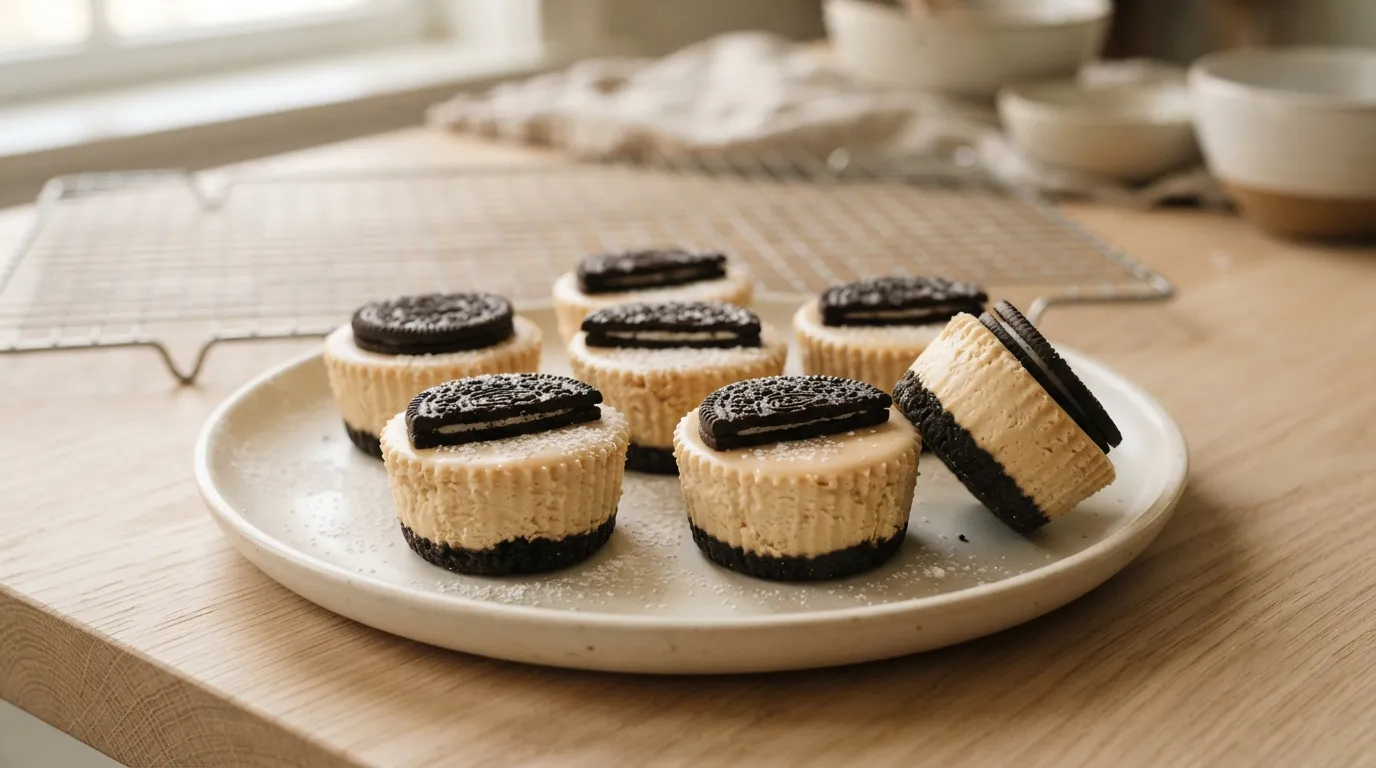
Ten individual cheesecakes, each one set between the two halves of an Oreo, and they are mini for a reason rather than for the look of it - a small chamber of fast, dry air suits a shallow custard and wrecks a deep one. Four ingredients, twenty minutes of work, eight minutes in the basket and half an hour in the fridge. The one instruction worth taking seriously is the first: the cream cheese has to be at room temperature before you start.
Ingredients
Quantities for 10 mini cheesecakes, in batches of 5 - the times on this page assume that much in the basket.
- 10 Oreo cookies
- 250g (9 oz) full-fat cream cheese, at room temperature - an 8 oz block is close enough
- 1 egg, lightly beaten
- 2 Mars bars (64g total), chopped - sold as a Milky Way in the US
- Powdered sugar, to dust (optional)
How to air fry mini oreo cheesecakes
- Split each cookie in half with the tip of a small knife, twisting rather than levering so the halves stay whole. Double up ten small paper cases - one inside another - and stand a cookie half in each, cream side up. Beat the cream cheese until smooth, beat in the egg, then microwave the chopped chocolate bars for about 45 seconds, stir until almost smooth and beat that through as well. Spoon two tablespoons of the mixture into each case and press a remaining cookie half on top, cream side down.
- Preheat the air fryer to 320°F (160°C).
- Add the fresh mini oreo cheesecakes to the basket. Stand the cases in a single layer with a gap between them and cook five at a time rather than squeezing in all ten - a standard basket only holds five without them touching, and a case pressed against its neighbour has nothing holding its side up as the filling softens.
- Cook for about 8 minutes.
- Check it has reached a safe internal temperature of 160°F (71°C).
- Lift the cases onto a wire rack and leave them until they stop steaming, about ten minutes. The filling is still slack enough to sag at this point, so this is not the moment to turn one out of its case.
- Chill for at least 30 minutes, or overnight. Dust with powdered sugar just before serving if you want it - any earlier and the sugar draws moisture out of the surface and vanishes into it.
Pro tip
Take the cream cheese out of the fridge a good hour before you start. Cold cream cheese will not blend - the fat is still firm, so it breaks into lumps rather than smoothing out, and the only way to force it is to beat harder, which whips air into the filling. Air is what makes a cheesecake dome up in the basket and then sink and crack as it cools, so a lumpy mixture and a cracked top are usually the same mistake twice.
How to tell when it's done
Eight minutes at 320°F (160°C) leaves the tops matt and just set, with a faint wobble in the middle when you nudge the case. That wobble is what firms up in the fridge, so a cheesecake that already looks solid in the basket is slightly overdone. The filling is an egg custard, so if you want certainty rather than a judgement, sacrifice one and probe it - 160°F (71°C) is the USDA figure for an egg-set mixture, and a probe leaves a hole you cannot hide, which is why you check one and not all ten. Note that it sits at the top of the range where a cheesecake filling sets rather than in the middle of it, so treat it as the number you stop at, not one to push past. A crack across the top means too long, too hot, or too much air beaten into the filling.
Safe internal temperature
Cook to 160°F (71°C) at the thickest point. An instant-read thermometer is the only reliable way to confirm it.
How to make Oreo cheesecake in an air fryer: why this recipe is mini and a full-size one is a bad idea
Cheesecake is not really baked, it is set. The egg proteins in the filling unfold and link into a soft solid at somewhere around 150-160°F (65-71°C), and a few degrees above that the same links tighten and start squeezing water out from between them - which is what a grainy, weeping cheesecake with a sunken middle actually is. So the whole job is getting the coldest part of the mixture up to setting temperature without taking the outside past it. That is a problem about distance, and distance is the thing a mini portion doesn't have.
Two tablespoons in a small paper case is a layer well under an inch deep, so no part of the filling sits much more than a third of an inch from the air above it or the cookie below. The middle crosses its setting temperature within a minute or so of the edge, and eight minutes is over before the edge has time to overshoot. Now scale that up. A full-size cheesecake is three inches deep, the centre is an inch and a half from anything, and heat travels through a wet custard slowly - so the outer half sits above setting temperature for the best part of an hour while the middle catches up. In an oven you fix that with a water bath, which is a genuinely clever piece of physics: water cannot exceed 212°F (100°C) while it is still liquid, so a tin standing in it has a hard ceiling clamped around its sides no matter what the dial says, and the steam slows the whole ramp down.
You cannot rebuild that in a basket. There is no room for a bath around the tin, the fan would drive the water everywhere, and the trick this site does use - a spoonful of water in the drawer beneath the basket, which pins rendered fat to boiling point and is why it stops a machine smoking - protects the machine, not the food; the air in the chamber is still whatever the dial says. An air fryer is a small box of fast, dry, unbuffered heat, which is the exact opposite of what a deep custard wants and precisely what a shallow one wants. Hence ten small ones. If you want a whole cheesecake, use the oven and the bath, and use the air fryer for the version it is actually good at.
Converting from an oven recipe
If your recipe is written for a conventional oven, lower the temperature by about 25°F (15°C) and reduce the time by roughly 20% to land near 320°F for 8 minutes. Need a different starting point? Use the conversion calculator.
Air fryer mini oreo cheesecakes: FAQ
Can you make cheesecake in an air fryer?
Yes, as long as it is a shallow one. Individual cheesecakes well under an inch deep set right through in eight minutes at 320°F (160°C), because no part of the filling is far from the heat and the middle crosses its setting temperature at almost the same moment as the edge. A full-size cheesecake is the case to avoid: it needs the centre brought gently up to around 150-160°F (65-71°C) while the outside is held below it, which in an oven is what a water bath is for, and there is no way to run a water bath inside an air fryer basket. Fast dry air with nothing buffering it will set the outer inch hard and grainy long before the middle has set at all.
Do air fryer cheesecakes need to be chilled before eating?
Yes, and half an hour is the minimum rather than a suggestion. Heat is what sets the egg, but cold is what gives a cheesecake its texture: the butterfat in the cream cheese is soft and semi-liquid at room temperature and only firms up properly below about 60°F (15°C), so the same cheesecake that is slack and slightly greasy warm is dense and sliceable cold. Straight out of the basket the filling is still loose enough to sag if you lift it from its case, and the flavour is flat - fat coats the tongue when it is warm and mutes the tang of the cream cheese along with it. Thirty minutes in the fridge is enough for something this small; overnight is better if you have the time, and they keep for three days covered.
Why did my air fryer cheesecake crack?
Almost always air, heat or a draught, in that order. Air beaten into the filling expands in the basket and lifts the surface into a dome, then leaves as it cools and drops the middle out from under a skin that has already set - that is a crack, and the usual cause is cold cream cheese, because lumps make you beat harder and harder is how air gets in. Too hot or too long is the second cause, and it is worth being straight about how narrow the margin is: the filling sets at around 150-160°F (65-71°C) and begins contracting and squeezing out water not far above that, which is exactly why the instruction is to pull them while the middle still wobbles. A cheesecake that looks solid in the basket has usually already gone past it. The third cause is cooling too fast, which is why they go onto a rack for ten minutes rather than straight into the fridge. A cracked cheesecake is still a good cheesecake, and a dust of powdered sugar hides it entirely.
Can I use a different chocolate bar instead of a Mars bar?
Yes, but match the type or the filling sets differently. A Mars bar - sold as a Milky Way in the US - is caramel and nougat under milk chocolate, and the caramel is what keeps the chilled filling soft and sliceable rather than firm, so any caramel-nougat bar behaves the same way. Swap in plain chocolate and you get a denser, more truffle-like set, because cocoa butter is hard at fridge temperature and there is no caramel left in the mixture to stay soft against it; use about 60g and expect to cut rather than spoon. White chocolate works and is noticeably sweeter, and it also scorches faster in the microwave - drop to 30 seconds and stir. Whatever you use, melt it just to the point where it stirs smooth. Chocolate taken too far turns thick and grainy, and beating that into cream cheese gives you a gritty filling that no amount of chilling will fix.
How long does it take to air fry mini oreo cheesecakes?
Air fry mini oreo cheesecakes at 320°F (160°C) for about 8 minutes. That's for 10 mini cheesecakes, in batches of 5 in a single layer; adjust slightly for a fuller basket or a different model.
What temperature do you air fry mini oreo cheesecakes at?
Set the air fryer to 320°F (160°C). If you're converting an oven recipe, that's roughly 25°F (15°C) below the oven temperature, with the time cut by about 20%.
Do I need to preheat the air fryer for mini oreo cheesecakes?
A 2-3 minute preheat gives the most accurate timing and the best browning, but it isn't essential - if you skip it, add a minute or two to the cook time.
What's the safe internal temperature for mini oreo cheesecakes?
Cook mini oreo cheesecakes to a safe internal temperature of 160°F (71°C), measured at the thickest point with an instant-read thermometer. Cooking time is a guide; internal temperature is what confirms it's safely done.