Air Fryer Hard Boiled Eggs
Temperature
250°F
120°C
Time
15 min
6 eggs
Safe internal
160°F
71°C · piping hot
Prep
None
Cook
15 min
Total
15 min
The air fryer 'hard-boils' eggs in the shell with no pot of water, and they often peel more easily afterwards. It's handy for cooking a batch at once for the week's lunches.
Ingredients
Quantities for 6 eggs - the times on this page assume that much in the basket.
- 6 eggs, straight from the fridge
- Ice water, for cooling them afterwards
How to air fry hard boiled eggs
- Preheat the air fryer to 250°F (120°C).
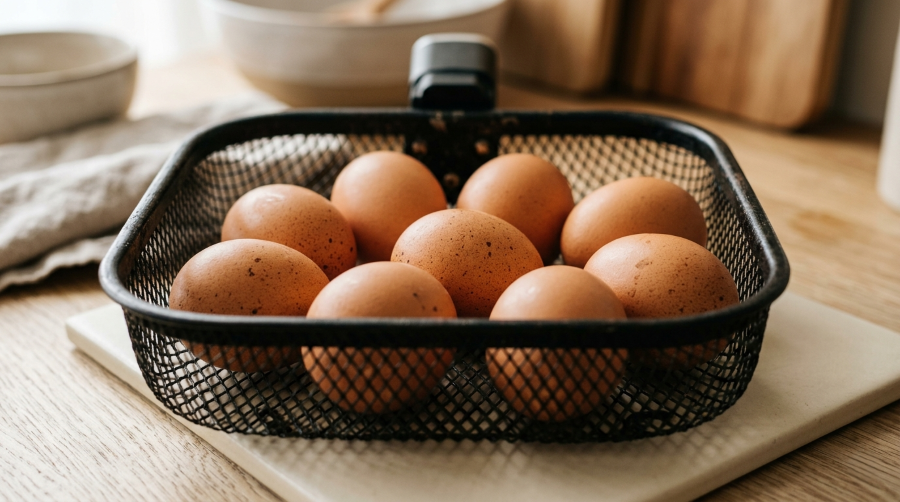
- Add the fresh hard boiled eggs to the basket. Set the eggs in a single layer.
- Cook for about 15 minutes.
- Check it has reached a safe internal temperature of 160°F (71°C) before serving.
Pro tip
Ice bath immediately after for easy peeling.
How to tell when it's done
At 250°F (120°C) for about fifteen minutes the yolk sets right through; knock a couple of minutes off for softer yolks. Move them straight into a bowl of ice water, which stops the cooking and makes peeling easier.
Safe internal temperature
Cook to 160°F (71°C) at the thickest point. An instant-read thermometer is the only reliable way to confirm it.
How to make hard boiled eggs in the air fryer: nothing is boiling, which is why the temperature is the lowest on this site
Six eggs at 250°F (120°C) for fifteen minutes, in a single layer, left alone, then straight into ice water. The thing worth understanding about how to make hard boiled eggs in the air fryer is that 250°F is the lowest setting of the eighty foods on this site, and the next one up is the other egg - our scrambled eggs page, at 300°F - with nothing else on the whole chart below 320°F. That is not caution. It is the machine handing back a job the saucepan used to do for nothing.
Boiling water is self-limiting. It cannot go past 212°F (100°C) while it is still liquid, because every extra bit of energy you put under the pan goes into turning water into steam rather than into making it hotter. So it makes no difference how hard the hob is going or how long you forget about them: the outside of the white is never exposed to more than 212°F. An air fryer has no ceiling of that kind at all - the number on the dial is simply the temperature the shell meets. This site uses the same fact deliberately in the other direction elsewhere, in the trick of putting a spoonful of water in the drawer beneath the basket, which pins rendered fat to boiling point and is why it stops the machine smoking. Here you are on the losing side of it. Run eggs at the 380-400°F most of this chart uses and the white pressed against the shell keeps coagulating long past the 180°F or so it actually needed, squeezing water out from between the proteins and going rubbery, while the middle is still catching up. 250°F is where you put the ceiling back by hand.
The other thing the water was doing was acting as a reservoir, and it is worth knowing you have lost that too. A pan of boiling water is a large store of heat that barely notices six cold eggs arriving in it, whereas the air in a basket holds almost none - so here the eggs' own coldness is the biggest thing in the chamber. That is why the fifteen minutes on this page is written for six eggs straight from the fridge, and why it moves when either of those changes: eggs that have been sitting out on the counter come out softer on the same timer, and a basket packed to the walls runs long. A pot would have swallowed both without you noticing. It is also why air, despite being forty degrees hotter here than boiling water ever gets, still takes longer to do the job - it is a far poorer conductor, and a hotter medium that carries heat badly is not a faster one.
Converting from an oven recipe
If your recipe is written for a conventional oven, lower the temperature by about 25°F (15°C) and reduce the time by roughly 20% to land near 250°F for 15 minutes. Need a different starting point? Use the conversion calculator.
Air fryer hard boiled eggs: FAQ
Why does my air fryer boiled egg have brown spots on the shell?
Because it is browning, and those marks are the clearest sign that nothing here is boiling. The explanation you will usually be given is that fast-moving air puts pressure on the shell, which does not hold up - pressure does not brown anything. A shell is not inert: it carries a thin organic layer, and in dry heat organic material colours once it gets past about 212°F (100°C), which is the same threshold everything else on this site has to clear before it can brown at all. In a pot the shell is wet and pinned at boiling point, so it never gets there and never marks. The patch is always heaviest where the egg rests on the basket, for the reason this site keeps coming back to - metal conducts heat far better than air does. None of it matters: the marks are on the outside of the shell, they go in the bin with it, and the ice bath takes most of them off first. The one case worth telling apart is scattered dark specks rather than a tan patch where the egg sat - that is usually debris coming off a dirty element, and it is a cleaning job rather than the egg browning at all.
How long does it take to air fry hard boiled eggs?
Air fry hard boiled eggs at 250°F (120°C) for about 15 minutes. That's for 6 eggs in a single layer; adjust slightly for a fuller basket or a different model.
What temperature do you air fry hard boiled eggs at?
Set the air fryer to 250°F (120°C). If you're converting an oven recipe, that's roughly 25°F (15°C) below the oven temperature, with the time cut by about 20%.
Do I need to preheat the air fryer for hard boiled eggs?
A 2-3 minute preheat gives the most accurate timing and the best browning, but it isn't essential - if you skip it, add a minute or two to the cook time.
What's the safe internal temperature for hard boiled eggs?
Cook hard boiled eggs to a safe internal temperature of 160°F (71°C), measured at the thickest point with an instant-read thermometer. Cooking time is a guide; internal temperature is what confirms it's safely done.