Air Fryer Scrambled Eggs
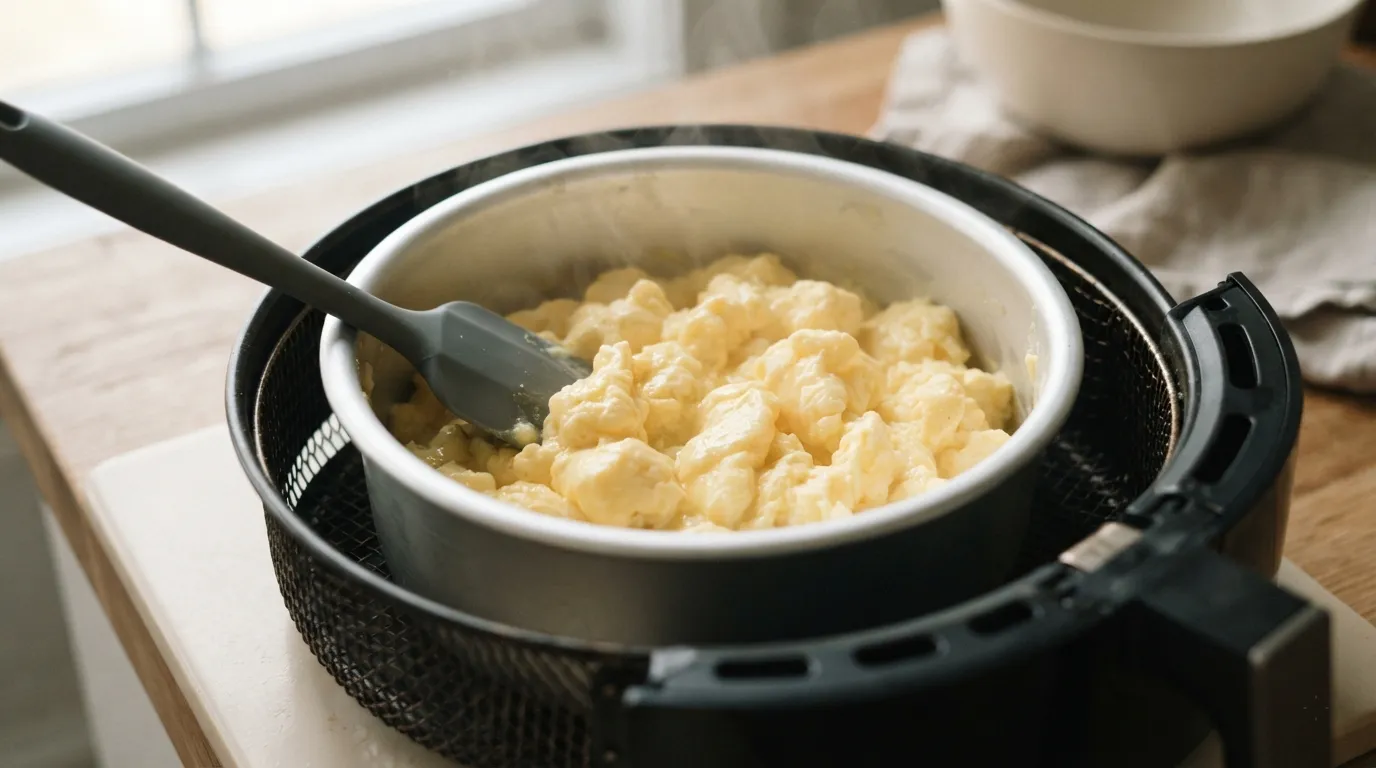
Temperature
300°F
150°C
Time
12 min
4 eggs (serves 2)
Safe internal
160°F
71°C · piping hot
Prep
3 min
Cook
12 min
Total
15 min
Four eggs take about 12 minutes at 300°F (150°C) in a buttered 6-inch metal pan, stirred twice, and they are done the moment no loose egg is left. That is three or four times what a hob would take, and the reason to do it anyway is that none of those twelve minutes needs you standing over it. This and our hard boiled eggs page hold the two lowest settings on this site, and for the same reason - an egg is one of the few things here that a hot machine can only make worse.
Ingredients
Quantities for 4 eggs (serves 2) - the times on this page assume that much in the basket.
- 4 large eggs
- 2 tbsp whole milk
- 1 tsp butter, for the pan
- 1/4 tsp fine salt
- A pinch of black pepper
How to air fry scrambled eggs
- Butter the pan and take it up the sides. Egg sets against hot metal wherever it touches, and here it is against a solid floor and the wall all the way round it for twelve minutes rather than bridging the gaps in a basket, so a buttered pan is the difference between tipping the eggs out and scraping them out. Whisk the eggs with the milk, salt and pepper until the colour is even and no clear streaks of white are left, then pour them in.
- Preheat the air fryer to 300°F (150°C).
- Add the fresh scrambled eggs to the basket. The pan is what goes in, not the egg - beaten egg poured onto a perforated crisper plate runs straight through into the drawer. A 6-inch metal cake pan holds four eggs at about half an inch deep, which is the depth these times are written for, and it wants a clear inch of air all the way round it so the fan can reach the outside of the pan, which is how the pan gets hot in the first place.
- Cook for about 12 minutes, stirring the set edge in towards the middle at 4 minutes and again at 8.
- Check it has reached a safe internal temperature of 160°F (71°C) before serving.
Pro tip
The pan is doing the cooking here, so what it is made of sets the pace. A thin aluminium or steel cake pan is at working temperature within a minute of the drawer closing; stoneware, glass and cast iron all spend several minutes soaking heat up first and then hand it over slowly, so twelve minutes in a ceramic dish is a looser, wetter scramble than twelve minutes in a cake pan. Our ceramic page has the other reason to prefer metal - an air fryer comes up to temperature fast enough to crack a cold dish that went in straight from the cupboard.
How to tell when it's done
The cue is visual and the window is narrow. Tilt the pan: while there is still loose, glossy egg running between the curds, it is not there yet; the moment nothing runs, it is, and it should still look soft and wet rather than dry and grainy. That state is around 160°F (71°C), the USDA figure for a cooked egg dish, and if you want to read it, lay the probe flat into the mass rather than hunting for a thickest point - half an inch of egg has not got one. What you must not read is the surface. It dried out several minutes ago and tells you nothing at all about what is underneath it.
Safe internal temperature
Cook to 160°F (71°C) at the thickest point. An instant-read thermometer is the only reliable way to confirm it.
Scrambled eggs in the air fryer: there is no such thing as taking them off the heat
Every set of directions for scrambled eggs in the air fryer says much the same five things, and four of them are simply right. Cook them in a small pan, because beaten egg on a crisper plate is a puddle in the drawer. Run it at 300°F (150°C), because much above 325°F the edge seizes before the middle has set. Stir it two or three times. Drag the set outside in towards the middle when you do. And then the fifth: take them out looking a shade underdone and let the residual heat in the pan finish them off. That last one is excellent advice about a skillet. It has been carried across without anyone checking whether the vessel it describes is the vessel you are holding.
On a hob the heat and the pan are two separate objects. A burner warms the base and nothing else, so the walls run cooler, the rim and the handle cooler still, and the whole thing sits a few inches above a flame you can turn off or simply lift it away from. That is what off the heat means, and it is why residual heat in a skillet is a modest, fairly predictable top-up. In a basket there are not two objects. The pan has been sitting in 300°F air on every face for twelve minutes - base, walls, and the bare strip of rim above the egg line, which has no eggs behind it to hold it back and is the hottest metal in the machine. There is nothing to lift it off, because the air is not what has been cooking the eggs. Our steak page puts it plainly: metal is enormously better than air at pushing heat into food, which is why a flat face against the basket browns the way it would in a pan almost everywhere else on this site. Here it means near enough all of the heat in these eggs arrived through the pan, and none of it stops arriving when you open the drawer. Opening the drawer takes away the air. The air was never the thing.
So the move a hob gives you for nothing has no equivalent in this machine, and the only version of it available is getting the eggs out of the pan rather than the pan out of the fryer. Two plates, straight away, and let them settle there where nothing is heating them. It is also the reason the timing on this page is written to the moment the loose egg stops running rather than to a shade before it - the pan takes them the rest of the way whether you meant it to or not, and a scramble tipped out at that point arrives at the table soft, where one left sitting in the pan for the ninety seconds it takes to make toast does not.
The one surface the air does reach is the top, and it is worth being exact about what it does there, because it is the only thing happening here that an oven would not do. Fast dry air pulls moisture off a surface - that is this machine's whole speciality - and on a scramble it is being aimed at the single face you want left alone. That is the second job the stir is doing and nobody names it: each time you drag the set edge in, you are also burying a dried skin into wet egg, which is the only way that face gets undone. It is why the interval matters more here than at a hob, where the top of the eggs is losing heat to the room rather than being blown at. Two stirs in twelve minutes is what four eggs need, and if you are only going to make one of them, make it the first - at four minutes, before the skin has anything to hold itself together with. The milk on the ingredient list is buying the same thing from the other end. Diluting egg raises the temperature at which it sets, so the gap between not yet and gone is wider, and a wider gap is worth paying for when you only get to look at it twice.
Converting from an oven recipe
If your recipe is written for a conventional oven, lower the temperature by about 25°F (15°C) and reduce the time by roughly 20% to land near 300°F for 12 minutes. Need a different starting point? Use the conversion calculator.
Air fryer scrambled eggs: FAQ
Can you cook scrambled eggs in an air fryer without a pan?
No - there is nothing to cook them in. A crisper plate is perforated and beaten egg is a liquid, so it runs straight through into the drawer; our ceramic page files this under the things a bare basket cannot do, along with baked eggs and anything else wet enough to go through the holes. It does not have to be a cake pan, though. A small oven-safe dish, a ramekin, a silicone loaf mould or the pan out of an accessory set all work, and what changes between them is the timing rather than the method - see the tip above for why. The one improvisation worth warning about is a foil tray you have folded yourself. Four beaten eggs spread across a wide sheet weigh very little, and an unweighted sheet is exactly the arrangement our aluminum foil page says the fan lifts into the element.
Are air fryer scrambled eggs quicker than doing them in a pan?
No, and it is worth saying plainly, because most of the pages on this dish sell it on being fast. Four eggs in a non-stick pan on a medium hob are done in three or four minutes. Here they are twelve, plus the preheat, and what comes out is a firmer, curdier scramble rather than the loose folds you get from something you are standing over and working constantly. What you buy with the extra eight minutes is that they are not eight minutes of your attention: you pour, you stir twice, and the hob is free for the rest of the breakfast. It also scales in a way a pan does not, as long as you scale it the right way - eight eggs want a wider pan at the same half-inch depth, not the same pan filled twice as deep. Depth is the distance the heat has to travel; area is free.
How long does it take to air fry scrambled eggs?
Air fry scrambled eggs at 300°F (150°C) for about 12 minutes, stirring the set edge in towards the middle at 4 minutes and again at 8. That's for 4 eggs (serves 2) in a single layer; adjust slightly for a fuller basket or a different model.
What temperature do you air fry scrambled eggs at?
Set the air fryer to 300°F (150°C). If you're converting an oven recipe, that's roughly 25°F (15°C) below the oven temperature, with the time cut by about 20%.
Do I need to preheat the air fryer for scrambled eggs?
A 2-3 minute preheat gives the most accurate timing and the best browning, but it isn't essential - if you skip it, add a minute or two to the cook time.
What's the safe internal temperature for scrambled eggs?
Cook scrambled eggs to a safe internal temperature of 160°F (71°C), measured at the thickest point with an instant-read thermometer. Cooking time is a guide; internal temperature is what confirms it's safely done.