Air Fryer Rib Eye Steak
Temperature
400°F
200°C
Time
13 min
2 rib eye steaks, about 1 1/4 inches thick
Safe internal
145°F
63°C · piping hot
Prep
5 min
Cook
13 min
Total
18 min
A rib eye is the one steak where the fat is on the inside. Everywhere else on this site fat is a surface thing - a cap to crisp on a lamb chop, grease running out of a burger and away through the perforations - but a ribeye's marbling sits locked between the muscle fibres with nowhere to drain to. That usually gets written up as insurance, on the grounds that a well-marbled steak survives a few minutes either way. It is true at the top of the range and misleading at the bottom: firm fat is not a feature, so a rib eye pulled short is rare meat with hard seams running through it, and those seams are the thing you paid for. Which is what makes the basket a good match here rather than a compromise. Our steak page explains why moving air is poor at building a crust and why a thin steak belongs in a pan; the other half of that argument is that an air fryer is unusually good at walking a thick cut evenly up to temperature - and an even climb is exactly what marbling asks for, because the fat has to pass its rendering point right across the cross-section and not merely at the middle.
Ingredients
Quantities for 2 rib eye steaks, about 1 1/4 inches thick - the times on this page assume that much in the basket.
- 2 rib eye steaks, about 1 1/4 inches thick (350g each)
- 1 tsp oil
- Flaky salt and coarse black pepper
How to air fry rib eye steak
- Take the steaks out of the fridge about half an hour before they go in. On a cut this thick a fridge-cold middle is what leaves a cool band through the centre, and half an hour is enough to take the edge off it. Pat them dry, rub with the oil, and season heavily on both faces and along the fat edge with flaky salt and coarse pepper. If the fat cap is thick, score it every inch or so, just through the fat and not into the meat.
- Preheat the air fryer to 400°F (200°C).
- Add the fresh rib eye steak to the basket. Lay them flat with a gap between them - a rib eye is a wide steak, and where two overlap that face sits out of the airflow and stays pale.
- Cook for about 13 minutes, flipping them once halfway through.
- Check it has reached a safe internal temperature of 145°F (63°C) before serving.
Pro tip
Pull it about 5°F below the number you actually want. A steak this thick carries on climbing while it rests, so 130°F (54°C) out of the basket settles at around 135°F (57°C) on the plate - and on a rib eye those last few degrees are the ones doing the work.
How to tell when it's done
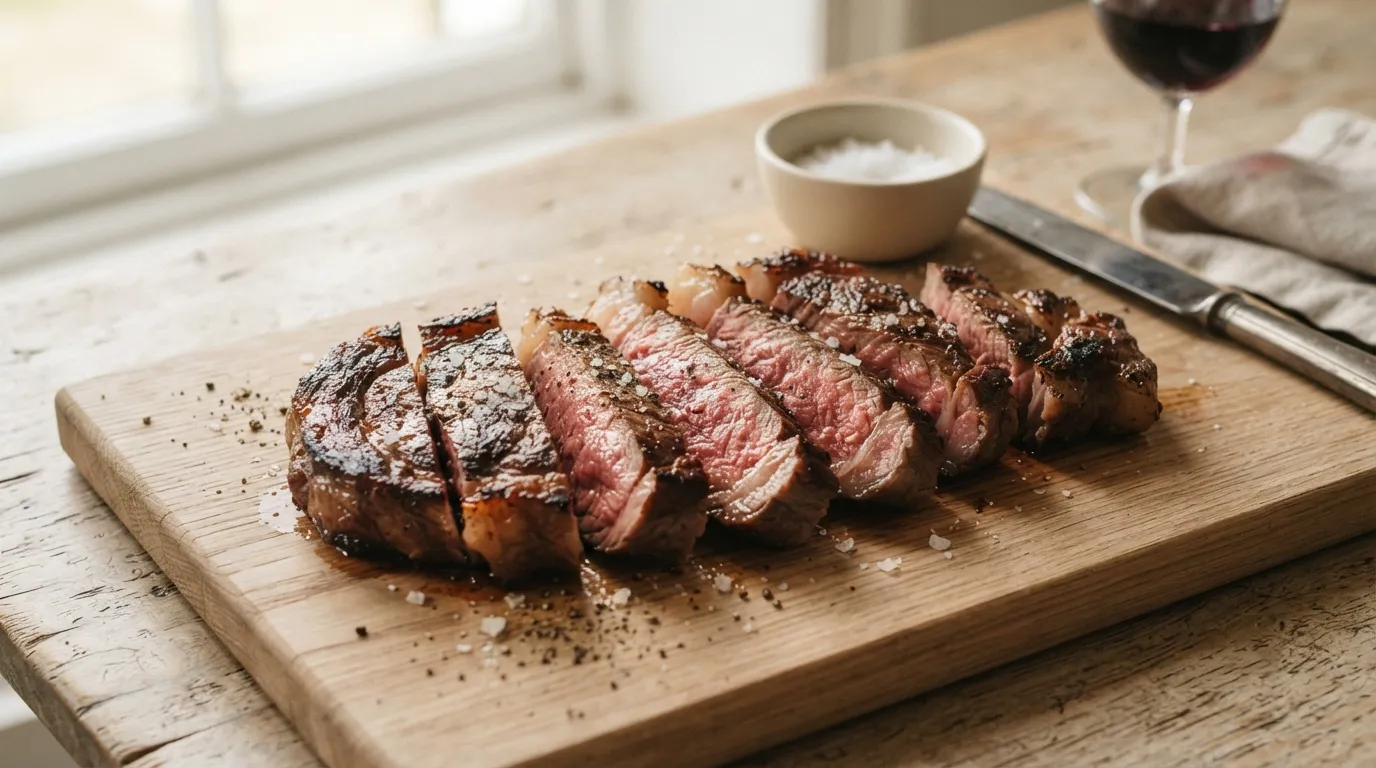
This is a thermometer job rather than a clock job. 145°F (63°C) is the USDA safe minimum for a whole cut of beef, and where in the range below it you eat a steak is a judgement you make for yourself. What is specific to a rib eye is *where* to aim: leaner steaks are at their best around 130°F (54°C), and a ribeye is generally better a few degrees further on, nearer 135°F (57°C). That is chemistry rather than preference, and it is well established rather than anything this page discovered: the fat threaded through the muscle is still firm at the temperature a lean steak is best at, and only starts giving way as you move up through the low 130s. So a rib eye pulled where a sirloin would shine is a steak with its best part left unmelted. Pull it around 5°F short of your target, rest it five minutes, and let carryover finish the job.
Safe internal temperature
Cook to 145°F (63°C) at the thickest point. An instant-read thermometer is the only reliable way to confirm it.
Converting from an oven recipe
If your recipe is written for a conventional oven, lower the temperature by about 25°F (15°C) and reduce the time by roughly 20% to land near 400°F for 13 minutes. Need a different starting point? Use the conversion calculator.
Air fryer rib eye steak: FAQ
Should you trim the fat cap off a ribeye before air frying?
Leave it on, but do not expect the basket to deal with it. A ribeye carries two quite different fats and only one of them is the point. The marbling inside the muscle is what you are paying for, and it renders where the meat is - that is what the temperatures on this page are chosen around. The cap on the edge is a solid seam of fat, and thirteen minutes at 400°F (200°C) is nowhere near enough to render it through; it will brown and soften on the outside and stay firm underneath. That is not a fault, it is what a short cook does to a deep seam of fat - and depth is what decides it rather than the clock. Our lamb chops render their fat edge in eight minutes, less time than this page gives a rib eye, because that edge is a few millimetres deep where a rib eye cap can be ten times as thick. So cook with it on - it shields that edge and holds seasoning - then trim whatever you do not want once it is on the board. Scoring it every inch or so beforehand is worth the ten seconds: the seam tightens as it heats, and an unscored cap is what pulls a steak into a curve so one face stops meeting the basket.
How long does it take to air fry rib eye steak?
Air fry rib eye steak at 400°F (200°C) for about 13 minutes, flipping them once halfway through. That's for 2 rib eye steaks, about 1 1/4 inches thick in a single layer; adjust slightly for a fuller basket or a different model.
What temperature do you air fry rib eye steak at?
Set the air fryer to 400°F (200°C). If you're converting an oven recipe, that's roughly 25°F (15°C) below the oven temperature, with the time cut by about 20%.
Do I need to preheat the air fryer for rib eye steak?
A 2-3 minute preheat gives the most accurate timing and the best browning, but it isn't essential - if you skip it, add a minute or two to the cook time.
What's the safe internal temperature for rib eye steak?
Cook rib eye steak to a safe internal temperature of 145°F (63°C), measured at the thickest point with an instant-read thermometer. Cooking time is a guide; internal temperature is what confirms it's safely done.