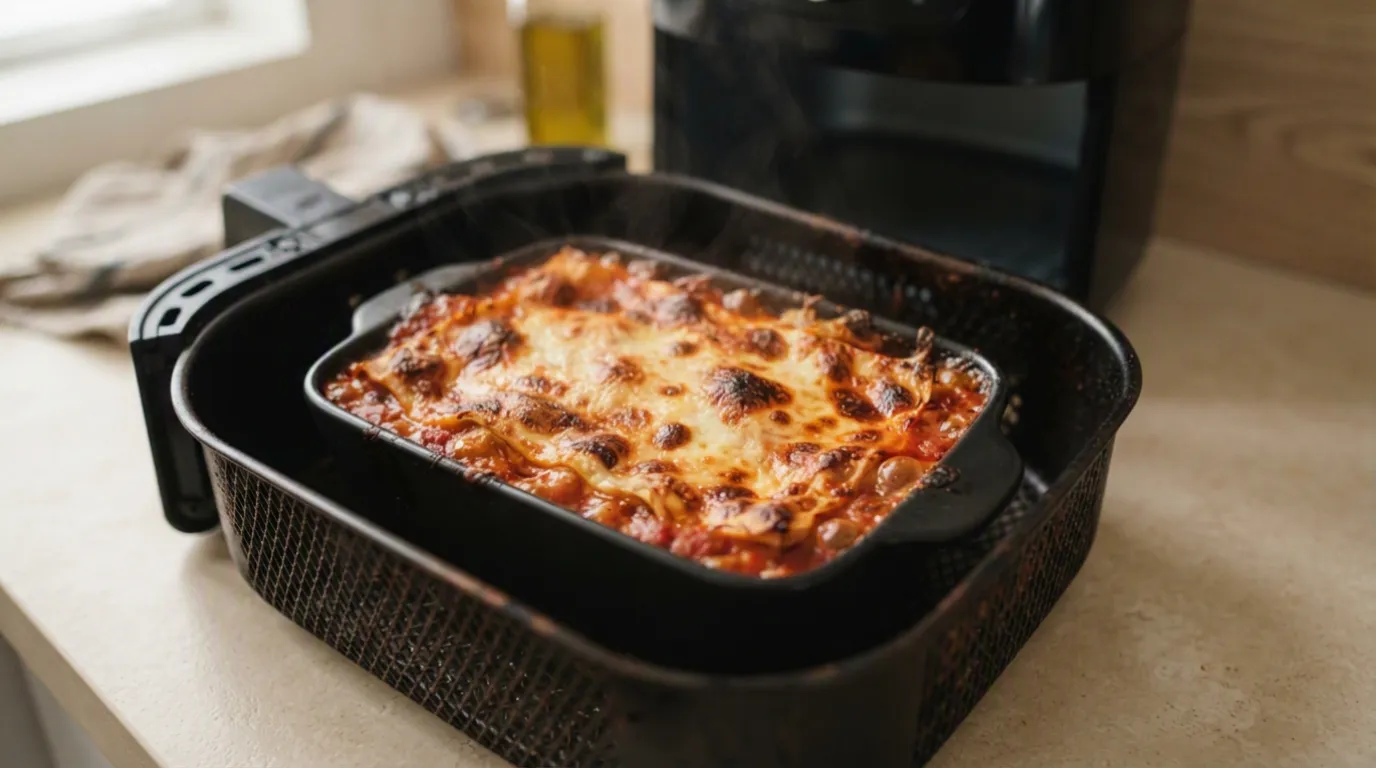
Stouffer's Lasagna in the Air Fryer
Temperature
350°F
175°C
Time
30 min
covered with foil for the first 20 minutes
Cook from
Frozen
no thawing
Short answer
Air-fry a single-serve Stouffer's lasagna at 350°F (175°C) for about 30 minutes from frozen - covered loosely with foil for the first 20, then uncovered for the last 10 to brown the cheese. It is ready when the middle reaches 165°F (74°C) and the sauce is bubbling at the edges. The family-size trays are too big; use the oven.
How to air fry stouffer's lasagna
What you need: 1 single-serve Stouffer's lasagna (10-12 oz, from frozen).
- Take the lasagna out of its sleeve and check the tray itself is marked oven-safe and fits the basket with room for air around it. If it is not, or it does not, turn the frozen block out into a small oven-safe dish.
- Cover the top loosely with foil - a lid rather than a wrapping, tucked lightly under the rim so the fan cannot lift it. Do not seal it tight; steam needs somewhere to go.
- Air-fry at 350°F (175°C) for 20 minutes, covered. Nothing much appears to happen in this stretch; the heat is working inwards.
- Take the foil off and cook for another 10 minutes to brown the cheese and reduce the sauce at the edges.
- Check the centre reads 165°F (74°C) before serving, pushing the thermometer into the middle of the block rather than near a corner. If it is short, put the foil back on and give it another 5 minutes. Let it stand a few minutes before cutting, or the layers slide apart.
Times written for a single-serve Stouffer's lasagna, the 10-12 oz tray. The family-size and party-size trays are not air fryer food - they do not fit a standard basket and the extra depth eats the time saving. Different varieties in the same tray size behave the same way; a meatier or cheesier one may want an extra few minutes, checked at the centre.
Why the air fryer suits it - and converting the box
This is the one item in this section where the air fryer's main talent is not what you want, and it is worth being straight about that. Everything else here has a crust or a coating, and the machine's whole job is to drive water off a surface and brown it. A lasagna has almost no surface to work with - it is a wet, dense, layered block whose virtue is moisture - and the small amount of browning it does want, on the cheese at the top, is the fastest thing on the plate. So the top would be dark and leathery while the middle was still frozen. The fix is the one instruction that appears nowhere else on this site: cover it. Foil over the top for the first two-thirds of the cook shields the cheese from the direct radiant heat coming off the element above, and traps enough steam to keep the pasta from drying at the edges, while the heat works inwards. Take the foil off for the last ten minutes and you get the browning back on your terms. This is the only page here that tells you to switch the appliance's headline advantage off for most of the cook, and that is not a criticism of the machine - it is what cooking a wet, thick thing in a small, fierce, fan-driven box actually requires.
The conversion is where this one is genuinely instructive, because it marks the edge of the rule the rest of this section runs on. A Hot Pocket and a can of biscuits both come down to roughly half their oven time in an air fryer. A single-serve lasagna does not - it comes down by about a third, and no amount of fan will do better. The reason is that a fan can only accelerate what happens at the surface. It replaces the still, slow-moving air against the food with fast air, which brings the outside up to temperature far quicker than an oven manages. But once the surface is hot, the heat has to travel inwards through the food itself, and that journey is set by the food's thickness and by how well it conducts - not by how hard the air is moving outside it. A thin pastry is nearly all surface, so the fan deletes nearly all the waiting. A frozen brick of pasta, sauce and ricotta is nearly all interior, so most of the half-hour is the middle slowly catching up and the fan is a spectator. The general rule for converting anything off a box: the thinner the food, the more of the oven's time the air fryer can take off.
That same reasoning is why the size on the tray matters more here than anywhere else in this section. The single-serve trays, around 10-12 oz, are the ones this page is written for: they fit most baskets and thirty minutes is a real saving. A family-size lasagna is a different proposition - it will not fit a standard basket at all, and even in a large oven-style air fryer the extra depth pushes the cook past the point where you have saved anything worth having. Use the oven for those; there is no trick here that beats the appliance the tray was designed for. And check what your tray is made of before it goes in. A rigid, oven-safe tray weighted down by a pound of frozen food is not the hazard a loose sheet of foil or a cardboard sleeve is - it cannot be picked up by the fan - but a microwave-only plastic tray has no business at 350°F. If the marking does not say oven-safe, or the tray does not fit, turn the block out into a small oven-safe dish instead.
What to watch for
- Burnt, leathery cheese over a cold middle - the sign it went in uncovered. The top of a lasagna is inches from the element and browns in minutes, while the frozen centre needs half an hour. The foil is not optional on this one, it is the whole method.
- A hot rim and a frozen core - normal at twenty minutes, a problem at thirty. Heat enters a dense block from every face and meets in the middle last, so the centre is always the last thing to be ready. Check it there, not at the edge, and give it more time at the same temperature rather than turning the heat up.
- Foil lifting into the element - the reason the cover goes on as a loose lid tucked under the rim rather than a sheet laid on top. Once the tray is uncovered for the last ten minutes there is nothing loose left in the basket, which is the safest way round to do it.
- Dry, curled edges with a wet middle - too long uncovered. If the cheese is where you want it before the centre is up to temperature, put the foil back on for the rest of the cook rather than pressing on and hoping.
Converting other frozen foods
The box usually gives oven directions and leaves the air fryer to you. Drop the temperature about 25°F and cut the time by a fifth, or use the conversion calculator - and see the cooking times chart for foods by the plateful.
Stouffer's Lasagna in the air fryer: FAQ
How long does Stouffer's lasagna take in the air fryer?
About 30 minutes at 350°F (175°C) for a single-serve tray from frozen - roughly 20 minutes covered with foil, then 10 uncovered to brown the top. Go by the centre rather than the clock: 165°F (74°C) in the middle of the block, with the sauce bubbling at the edges. It is less of a time saving than the air fryer gives on thin foods, because most of the cook is heat travelling into a dense frozen block, and that part is set by the food rather than by the fan.
Do you cover Stouffer's lasagna with foil in the air fryer?
Yes, for most of the cook, and it is the opposite of the advice for nearly everything else in an air fryer. The heating element sits just above the food, so the cheese on top browns within minutes while the frozen middle needs half an hour - uncovered, you get a burnt lid over a cold centre. A loose foil cover shields the top from that direct heat and holds in enough steam to stop the edges drying, then comes off for the last ten minutes so the cheese browns when you want it to. Tuck it under the rim rather than laying it on loose: an uncovered sheet is light enough for the fan to lift.
Can you cook a family-size Stouffer's lasagna in an air fryer?
Not really, and it is worth saying plainly rather than fudging it. A family-size tray will not fit a standard basket, and in a large oven-style air fryer the extra depth means the middle takes so long that the time saving disappears - which is the whole reason you reached for the machine. The single-serve trays are the ones worth air frying. For the big ones, use the oven the tray was designed for, and use the air fryer afterwards to reheat individual portions, where it is genuinely quicker.
More brand-name frozen foods
See every brand on the frozen brand-name foods hub, or work out any food with the cooking times chart.