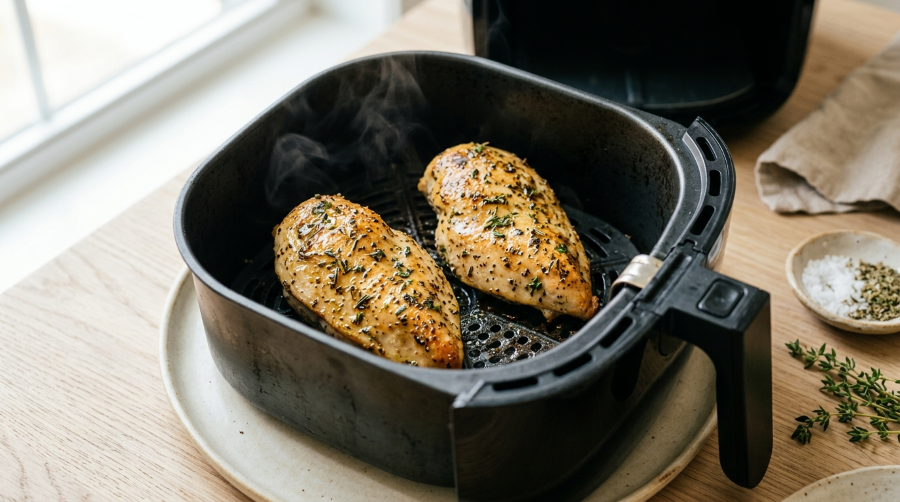
Air Fryer Chicken Breast
Temperature
375°F
190°C
Time
15 min
2 breasts (450g)
Safe internal
165°F
74°C · piping hot
Prep
5 min
Cook
15 min
Total
20 min
Chicken breast is one of the best things to start with in an air fryer. It tends to dry out in the oven, but the quicker, more direct heat keeps it juicy - give it a little oil and turn it over halfway. It's a fast, reliable weeknight protein.
Ingredients
Quantities for 2 breasts (450g) - the times on this page assume that much in the basket.
- 2 boneless, skinless chicken breasts (450g)
- 1 tsp olive oil
- 1 tsp smoked paprika
- 1/2 tsp garlic powder
- Salt and black pepper
How to air fry chicken breast
- Pat the breasts dry, rub them with the oil, then coat both sides with the paprika, garlic powder, salt and pepper. Drying them first is what lets the surface brown instead of steam.
- Preheat the air fryer to 375°F (190°C).
- Add the fresh chicken breast to the basket. Keep them in a single layer and don't stack.
- Cook for about 15 minutes, flipping them over halfway through.
- Check it has reached a safe internal temperature of 165°F (74°C) before serving.
Pro tip
Use a meat thermometer; pull at 165°F (74°C) for max juiciness.
How to tell when it's done
Check it's cooked right through to 165°F (74°C) at the thickest part - no pink in the middle and the juices running clear. If it still looks a bit glassy when cut, give it another two or three minutes.
Safe internal temperature
Cook to 165°F (74°C) at the thickest point. An instant-read thermometer is the only reliable way to confirm it.
How long to cook chicken breast in an air fryer: thickness sets the time, not weight
Two boneless, skinless breasts - about 450g between them - take 15 minutes at 375°F (190°C), turned over once at the halfway mark, and they are done when the thickest part reads 165°F (74°C). That figure is honest for a supermarket breast of roughly an inch to an inch and a half at its fattest point, which is what most packets hold. It is not a constant, though, and the thing that moves it is not the one on the label.
Heat has to travel from the surface to the middle, and the distance it travels is half the thickness. That is the whole of it. Conduction through meat is slow and it does not care how much chicken is in the basket, so two breasts side by side take the same 15 minutes as one, provided they are not touching and the air can still get round them. Thickness is different, because the relationship is not proportional - the time to bring the centre up climbs roughly with the square of the distance, so a breast half an inch fatter than the last one wants noticeably more than half an inch's worth of extra minutes. Weight is the number printed on the packet and it is the wrong number to cook by.
This is also the argument for flattening them, and it does more than any change to the dial would. A chicken breast is a wedge - thick at the shoulder end, tapering almost to nothing at the tip - so a single breast is really two thicknesses cooking in the same basket, and the thin end is finished and drying out while the fat end is still climbing. Put it between two sheets of parchment and beat it to an even three-quarters of an inch and the whole thing finishes at once, several minutes sooner. Butterflying it does the same job with a knife.
One trap is specific to this appliance. The fan strips the humid layer of air off the surface, so the outside dries and browns far faster here than it would in a still oven - that is the point of the machine, and on a thin cut it is all upside. On a thick breast it means the colour arrives early: the outside looks finished several minutes before the centre is safe. In an oven the browning tends to lag the interior, and here it leads it, which is why this page tells you to use a thermometer rather than to cook until golden. Golden is a fifteen-minute event on almost any breast. The centre is not.
Converting from an oven recipe
If your recipe is written for a conventional oven, lower the temperature by about 25°F (15°C) and reduce the time by roughly 20% to land near 375°F for 15 minutes. Need a different starting point? Use the conversion calculator.
Cooking from frozen instead? See our air fryer frozen chicken breast guide .
Air fryer chicken breast: FAQ
Why is my air fryer chicken breast dry?
Almost always because the outside overshot while you were waiting for the middle. A skinless breast is about as lean as meat gets, so the only thing keeping it moist is water held between the muscle fibers - and those fibers contract and wring that water out at a rate that climbs steeply once they are past about 150°F (65°C). The gap between 165°F (74°C) and 180°F (82°C) costs far more moisture than fifteen degrees sounds like it should. In an air fryer the moving air drives the outer layers through that band quickly, so on a thick or wedge-shaped breast the edges are well past it by the time the centre reaches 165°F. Three fixes, in order of how much they help: beat the breast to an even thickness so there is no thin end to sacrifice, oil the surface so it browns rather than evaporates, and pull it at 165°F on a thermometer instead of leaving it in for a safety margin it does not need.
How long does it take to air fry chicken breast?
Air fry chicken breast at 375°F (190°C) for about 15 minutes, flipping them over halfway through. That's for 2 breasts (450g) in a single layer; adjust slightly for a fuller basket or a different model.
What temperature do you air fry chicken breast at?
Set the air fryer to 375°F (190°C). If you're converting an oven recipe, that's roughly 25°F (15°C) below the oven temperature, with the time cut by about 20%.
Do I need to preheat the air fryer for chicken breast?
A 2-3 minute preheat gives the most accurate timing and the best browning, but it isn't essential - if you skip it, add a minute or two to the cook time.
What's the safe internal temperature for chicken breast?
Cook chicken breast to a safe internal temperature of 165°F (74°C), measured at the thickest point with an instant-read thermometer. Cooking time is a guide; internal temperature is what confirms it's safely done.