Air Fryer Chicken Wings
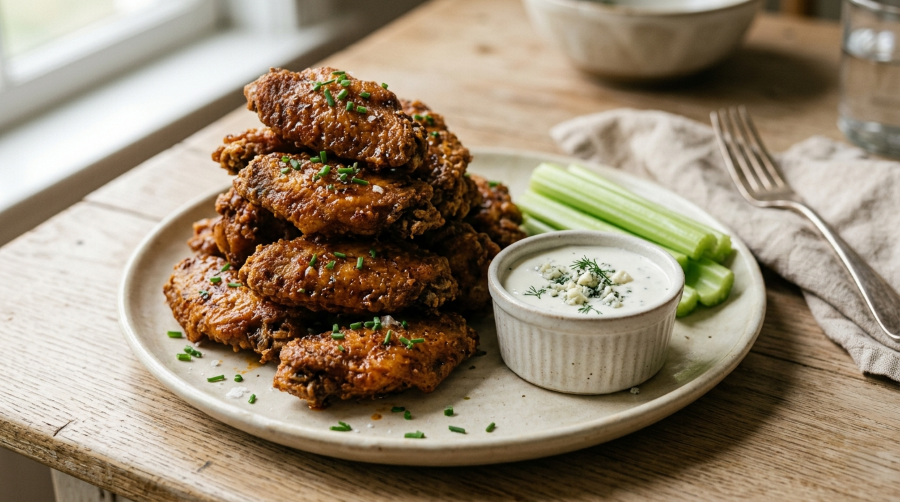
Temperature
400°F
200°C
Time
20 min
1kg (approx 12 wings)
Safe internal
165°F
74°C · piping hot
Prep
10 min
Cook
20 min
Total
30 min
Wings are a standout in the air fryer - every bit as crispy as deep-frying, with none of the oil or lingering smell. A little baking powder in the rub draws out moisture and gives you extra crunch.
Ingredients
Quantities for 1kg (approx 12 wings) - the times on this page assume that much in the basket.
- 1kg chicken wings (about 12)
- 1 tsp baking powder
- 1 tsp salt
- 1/2 tsp black pepper
How to air fry chicken wings
- Pat the wings thoroughly dry - surface moisture is what stops them crisping - then toss them with the baking powder, salt and pepper until every wing is evenly coated.
- Preheat the air fryer to 400°F (200°C).
- Add the fresh chicken wings to the basket. The basket can be full but not packed.
- Cook for about 20 minutes, shaking the basket two or three times so they crisp all over.
- Check it has reached a safe internal temperature of 165°F (74°C) before serving.
Pro tip
Pat dry thoroughly before seasoning; moisture is the enemy of crispiness.
How to tell when it's done
They're safe at 165°F (74°C), but taking them a bit further, to around 175-180°F, gives that proper crackle. Toss them in sauce only once they're out of the basket, or you'll lose the crisp.
Safe internal temperature
Cook to 165°F (74°C) at the thickest point. An instant-read thermometer is the only reliable way to confirm it.
Air fryer chicken wings recipe: the baking powder is chemistry, not baking
The whole air fryer chicken wings recipe is four ingredients and one idea: get the skin dry, make it alkaline, and let the moving air do the rest. There is no batter, no flour and no added oil, because a wing already carries all the fat it needs underneath its own skin. What it also carries is water, and water is the only thing standing between you and a wing that crackles.
Baking powder is what turns that from a hope into a method, and it is not there to make anything rise. It is largely sodium bicarbonate, which is alkaline, and lifting the pH of the skin does two useful things at once. Browning reactions run faster in alkaline conditions, so the skin takes on colour inside the cook time rather than needing another ten minutes it does not have. Alkalinity also breaks the skin's proteins into smaller fragments, and smaller fragments brown more readily still. On top of that the bicarbonate reacts with the wing's own juices and gives off carbon dioxide, blistering the surface into thousands of tiny bubbles. Crunch is surface area, and that is where the surface area comes from.
Two things undo it, and both are avoidable. Use baking powder, never baking soda - soda is pure bicarbonate with nothing to buffer it, and at the quantity that crisps a wing it tastes soapy and faintly metallic. And keep the basket to a single layer with gaps: a packed basket traps the steam every wing is giving off, and skin sitting in steam is not skin that is drying out. That is also the argument for the perforated basket over a baking tray. A wing renders a lot of fat, and on a solid tray it pools; here it falls straight through, so the underside meets moving air instead of shallow-frying in its own drippings.
Converting from an oven recipe
If your recipe is written for a conventional oven, lower the temperature by about 25°F (15°C) and reduce the time by roughly 20% to land near 400°F for 20 minutes. Need a different starting point? Use the conversion calculator.
Air fryer chicken wings: FAQ
How do you air fry frozen wings?
You can, but they will not crisp like fresh ones, and the reason is the baking powder. Frozen wings come out of the bag wet and stuck together, so there is no dry surface to coat and nothing for the coating to do. Start them at 400°F (200°C) for about 5 minutes purely to loosen the block apart, prise them into a single layer, then carry on for another 20-25 minutes, shaking two or three times. Confirm 165°F (74°C) at the thickest point before serving - that figure does not move because the wings started frozen. If you want the crackle, thaw them, pat them dry and follow the recipe above instead.
Should you cook chicken wings past 165°F?
165°F (74°C) is the safe minimum and a wing is perfectly good to eat there, but wings are one of the few cuts worth taking further. A wing is mostly skin, collagen and connective tissue rather than lean muscle, and collagen only begins converting to gelatin above roughly 160°F, carrying on well past it. Pull a wing at exactly 165°F and the meat against the bone can still be slightly rubbery; take it to 175-180°F (80-82°C) and that tissue has softened while the skin has had a few more minutes to render and blister. This is the opposite of chicken breast, where every degree past 165°F costs you moisture.
How long does it take to air fry chicken wings?
Air fry chicken wings at 400°F (200°C) for about 20 minutes, shaking the basket two or three times so they crisp all over. That's for 1kg (approx 12 wings) in a single layer; adjust slightly for a fuller basket or a different model.
What temperature do you air fry chicken wings at?
Set the air fryer to 400°F (200°C). If you're converting an oven recipe, that's roughly 25°F (15°C) below the oven temperature, with the time cut by about 20%.
Do I need to preheat the air fryer for chicken wings?
A 2-3 minute preheat gives the most accurate timing and the best browning, but it isn't essential - if you skip it, add a minute or two to the cook time.
What's the safe internal temperature for chicken wings?
Cook chicken wings to a safe internal temperature of 165°F (74°C), measured at the thickest point with an instant-read thermometer. Cooking time is a guide; internal temperature is what confirms it's safely done.