Air Fryer Turkey Breast
Temperature
350°F
175°C
Time
50 min
1 split breast (3 lb / 1.4 kg)
Safe internal
165°F
74°C · piping hot
Prep
10 min
Cook
50 min
Total
60 min
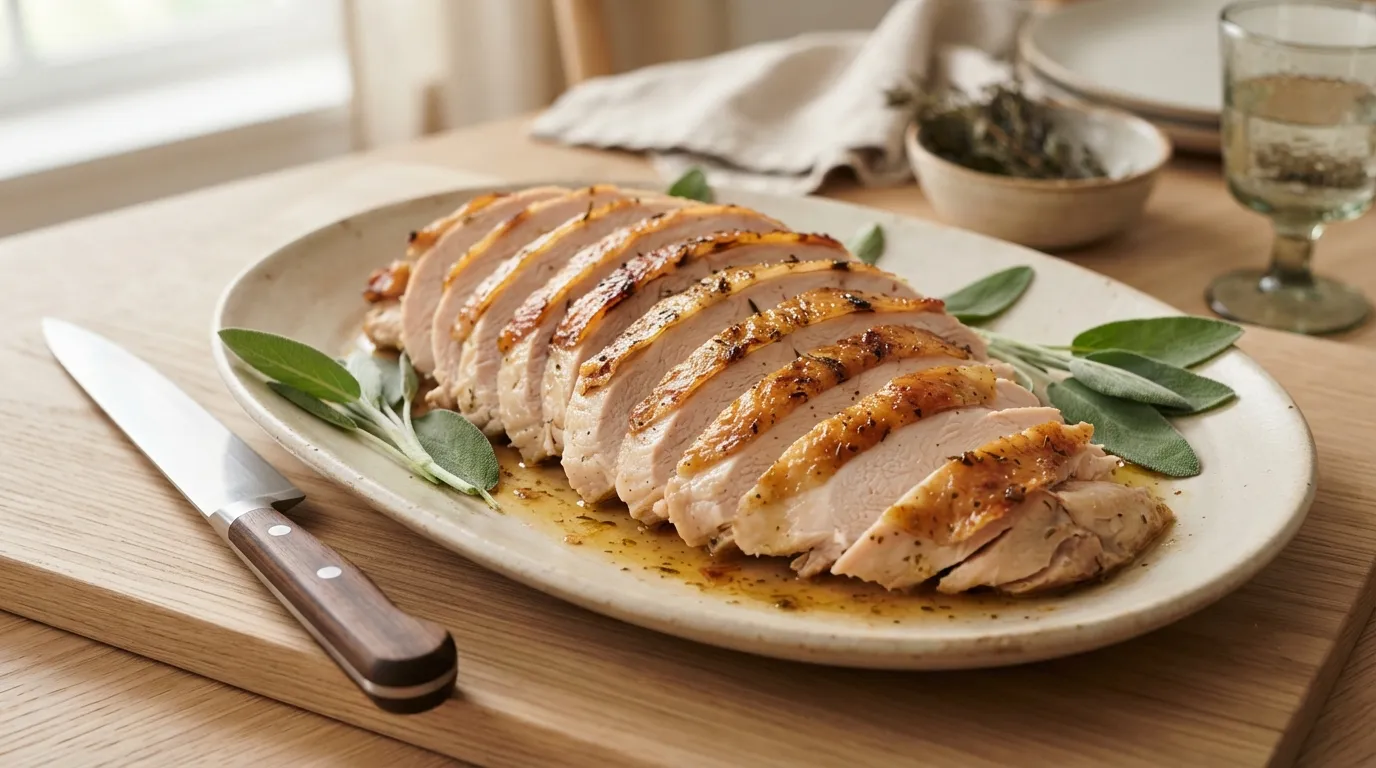
A split turkey breast takes 50 minutes at 350°F (175°C) - skin-side down for the first thirty-five and skin-side up for the last fifteen - and it is done when the thickest part of the meat reads 165°F (74°C). Three pounds is the size that fits a basket. The turn is the whole method here, and the moment to make it is not the halfway mark it is usually given as.
Ingredients
Quantities for 1 split breast (3 lb / 1.4 kg) - the times on this page assume that much in the basket.
- 1 split turkey breast, bone-in and skin-on (3 lb / 1.4 kg)
- 1 tbsp olive oil
- 2 tsp sage leaves, chopped
- 1 tsp garlic powder
- 1 tsp fine salt
- 1/2 tsp cracked black pepper
How to air fry turkey breast
- Pat the breast dry all over, and the skin especially - a wet skin cannot brown. Mix the oil with the sage, garlic powder and pepper, then work your fingers between the skin and the meat from the thick end to loosen it and push that mixture underneath. Salt the outside of the skin and leave it otherwise bare: for the last fifteen minutes that face sits directly under the element, and loose herbs scorch there long before the meat is ready.
- Preheat the air fryer to 350°F (175°C).
- Add the fresh turkey breast to the basket. One breast on its own, with nothing else in the basket. What to check before you close it is the headroom rather than the floor - a split breast is the tallest thing that goes in here, and it wants a good inch of clear air between the crown of the skin and the element. A 3 lb half breast is what a 5-6 quart basket takes; a whole 6-7 lb breast is a different proposition and mostly will not go in at all.
- Cook for about 50 minutes, starting it skin-side down and turning it skin-side up for the last 15 minutes.
- Check it has reached a safe internal temperature of 165°F (74°C) before serving.
Pro tip
Take the whole lobe off the frame before you slice it. Run the knife down either side of the ridge of bone until it meets the ribs, then follow the curve of the frame with the blade and lift the meat away in one piece - now you have a boneless roast on the board and you can slice straight across the grain. Sawing at it while it is still on the bone is the usual reason a carved breast arrives at the table in short torn pieces rather than slices, and that is a knife problem rather than a cooking one.
How to tell when it's done
165°F (74°C) at the thickest part of the meat, and on a split breast that lands somewhere awkward: the muscle is deepest at the wide end, right where it sits against the keel bone, so the point you need to read is the point nearest the thing you must not touch. Go in from the side and angle the probe along the meat rather than down at the bone - a probe resting on bone is reading the bone. The skin wants to be deep gold and drum-tight. You have the basket open at thirty-five minutes anyway to turn it over, so take a reading then - it costs nothing and it tells you whether the last fifteen minutes will be enough or whether this piece wants a few more. Then rest it ten minutes before carving.
Safe internal temperature
Cook to 165°F (74°C) at the thickest point. An instant-read thermometer is the only reliable way to confirm it.
When to turn a turkey breast in the air fryer: the skin's clock and the meat's clock do not scale together
Every method for this dish has the same two moves in it: start the breast skin-side down, then turn it skin-side up to finish. The reason usually given is that the first stretch renders the fat and gets the skin crisping, and the timings that go with it are fractions - skin down for twenty-five minutes of fifty, or roughly half of whatever the total turns out to be. Elsewhere on the same pages sits the same failure and the same remedy: on a bigger breast the skin goes too dark before the middle is there, so tent it with foil. Those two passages are usually in different sections and they are the same fact seen twice.
What separates the two positions is not subtle. In a basket air fryer the element sits above the food - our Pillsbury biscuits page sets that out and our pizza dough page inherits it rather than making the argument twice - so the upward-facing surface is in the element's line and in the fastest part of the airflow at once. The downward-facing one is lying on perforated metal under the weight of the piece. Both positions do something worth having - our bone-in chicken thighs page starts thighs skin-side down and treats that first stretch as the step that matters most. But only one of the two can burn the skin, and how many minutes the skin spends there is not decided by the bird. It is decided by you, at the moment you turn it over.
And the two things that decision has to serve do not grow at the same rate. Two clocks is our Tyson nuggets page's framing rather than this page's - a crust runs on the time it spends in moving air, the middle runs on how thick the piece is, and the two are independent of each other. There it settles a bag of mixed shapes at one temperature. Here the shapes are not mixed in the bag, they are sold across a range, and that turns the same pair of clocks into a different question. What the meat needs is set by the distance from its surface to its middle, which our chicken breast page works through in full: a bigger piece is a longer journey inwards, and it is the journey that sets the clock rather than the number on the label. What the skin needs is set by nothing of the sort. Skin is a sheet of roughly constant thickness whatever the bird weighed - a six-pound breast has not got thicker skin than a three-pound one, it has more of it - so the time it takes to go from pale to gold to past gold is much the same on both. One of the two clocks lengthens with the piece and the other does not move at all. "Turn it halfway" is a fraction. What the skin has is a quantity.
So count the turn back from the end rather than forward from the start. Fifteen minutes skin-up is what this page gives it, and that number should stay where it is when the piece gets bigger: the extra minutes a four-pound breast wants all belong on the front of the cook, skin-side down, and none of them belong to the skin. Turn a four-pounder at its own halfway mark instead and the skin gets better than half an hour up there, where fifteen minutes had already finished the job - and skin is the one part of this with nowhere left to go but darker. The published fractions survive at three pounds, which is the size nearly everyone writes the recipe at and the reason this has gone unnoticed; they stop surviving as the piece grows, and the recipes record that themselves when they tell you to cover a bigger breast. So the remedy is being applied to a schedule rather than to a bird. It is also the remedy this appliance is worst at holding. Our aluminum foil page hangs the whole of foil safety on one condition, which is that the food is weighing the sheet down before the fryer is switched on - an unweighted one gets lifted into the element - and a tent is that arrangement upside down: food underneath, nothing pinning it. Tenting the carved meat on a board afterwards is a different thing entirely and our roast beef page tells you to do it - it is the sheet inside the running machine that has no safe version. A schedule that never darkens the skin does not need one. Our pizza dough page calls its own flip a deadline for the opposite reason: there it is counted forward from the start, the last moment the base still has both faces free. Here it is counted backwards from the end. Same instruction, opposite anchor - and the anchor is the whole difference between a method that survives a bigger piece and one that does not.
Converting from an oven recipe
If your recipe is written for a conventional oven, lower the temperature by about 25°F (15°C) and reduce the time by roughly 20% to land near 350°F for 50 minutes. Need a different starting point? Use the conversion calculator.
Air fryer turkey breast: FAQ
Can you cook a whole turkey in an air fryer?
No, not in a basket air fryer. The limit is height rather than weight: our whole chicken page puts the ceiling at about 3.3 lb (1.5 kg), because past that the bird stops clearing the element and the crown cooks against it - and the smallest whole turkey on a supermarket shelf is somewhere around ten pounds. There is no version of this where the bird is simply cooked for longer. A breast is what fits, which is why this page is about one. Large countertop air fryer ovens are a different appliance with a different cavity and some are sold on taking a small bird; go by the manufacturer's own figure for yours rather than by a basket recipe's.
Can you cook a boneless turkey breast in an air fryer?
Yes, and in some ways it is the easier of the two - a boneless breast roast is usually 2 to 3 lb, netted into an even shape, with no bone to work a probe around and nothing to carve off afterwards. Leave the netting on until it is sliced. It wants the same 350°F (175°C) and the same rule about the turn, with the last fifteen minutes skin-side up if it has skin on it. What you should not carry across is the time: a netted roast is a different shape from a half breast on the bone, and it is the distance from the surface to the middle that sets the clock rather than the weight on the label - our chicken breast page explains why that is the number to cook by. Go to 165°F (74°C) and let the thermometer say when.
Can you cook a turkey breast from frozen in an air fryer?
No - thaw it first, and this is one of the few foods on this site where that is the answer. Cooking from frozen works when the food is thin, because the outside can afford to wait while a short distance thaws behind it. A 3 lb bone-in breast has a couple of inches of solid meat between its surface and its centre, so bringing that centre from frozen up to 165°F (74°C) means running everything outside it far past the point the skin and the outer inch of meat are any good. There is also nothing you can do to it while it is solid: you cannot dry the skin, season it or get under it. USDA allows 24 hours of fridge thawing per 4 to 5 lb, so a piece this size is a day-before job rather than a technique one.
How long does it take to air fry turkey breast?
Air fry turkey breast at 350°F (175°C) for about 50 minutes, starting it skin-side down and turning it skin-side up for the last 15 minutes. That's for 1 split breast (3 lb / 1.4 kg) in a single layer; adjust slightly for a fuller basket or a different model.
What temperature do you air fry turkey breast at?
Set the air fryer to 350°F (175°C). If you're converting an oven recipe, that's roughly 25°F (15°C) below the oven temperature, with the time cut by about 20%.
Do I need to preheat the air fryer for turkey breast?
A 2-3 minute preheat gives the most accurate timing and the best browning, but it isn't essential - if you skip it, add a minute or two to the cook time.
What's the safe internal temperature for turkey breast?
Cook turkey breast to a safe internal temperature of 165°F (74°C), measured at the thickest point with an instant-read thermometer. Cooking time is a guide; internal temperature is what confirms it's safely done.