Air Fryer Salmon Fillet
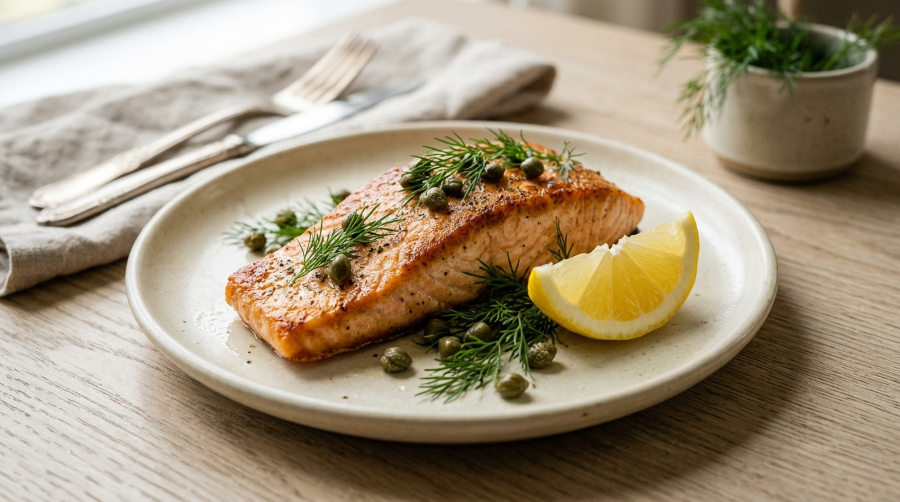
Temperature
380°F
195°C
Time
10 min
2 fillets
Safe internal
145°F
63°C · piping hot
Prep
5 min
Cook
10 min
Total
15 min
Salmon is a quick midweek option - about ten minutes, with far less of the fishy smell that lingers from a pan. Cook skin-on fillets skin-side down and the skin crisps up nicely.
Ingredients
Quantities for 2 fillets - the times on this page assume that much in the basket.
- 2 salmon fillets, skin on
- 1 tsp olive oil
- 1 tsp dill, chopped
- Salt and black pepper
- 1 tbsp capers, drained, to finish
- 1/2 lemon, cut into wedges, to serve
How to air fry salmon fillet
- Pat the fillets dry, brush them with the oil and season with the dill, salt and pepper. The capers go on when it comes out, with a wedge of lemon to squeeze over.
- Preheat the air fryer to 380°F (195°C).
- Add the fresh salmon fillet to the basket. Keep the fillets in a single layer.
- Cook for about 10 minutes, leaving it skin-side down rather than turning it.
- Check it has reached a safe internal temperature of 145°F (63°C) before serving.
Pro tip
Cook skin-side down. The skin protects the meat.
How to tell when it's done
It's cooked at 145°F (63°C), when it flakes with a fork and turns opaque, though many prefer to pull it a touch earlier for a softer middle. Don't leave it too long - salmon dries out fast.
Safe internal temperature
Cook to 145°F (63°C) at the thickest point. An instant-read thermometer is the only reliable way to confirm it.
Air fry salmon: the white curd is the fillet squeezing itself dry
That white stuff pushing out between the flakes is albumin, and it is not scum, not fat and not a sign you bought bad fish. Salmon muscle is built as short bundles of fiber held in sheets, which is why cooked fish flakes apart instead of pulling into strands. As those fibers heat they contract crosswise and wring liquid out of the flesh the way a twisted cloth does. Below about 120°F barely anything moves. Somewhere between roughly 130°F and 150°F the squeeze is at its hardest, and the liquid it drives to the surface carries albumin, a soluble protein that sets firm and opaque the moment it meets hot air. So the curd is a gauge, not a defect: the more of it you can see, the more moisture has already left the fillet.
Which is why the numbers on this page are 380°F and about ten minutes rather than 400°F and whatever it takes. Every extra degree of surface heat widens the band of fillet sitting in that hard-squeeze range at once. It also explains the failure mode specific to this appliance. A salmon fillet tapers - one end is a thick center cut, the other thins away to the tail - and a fan drives heat into the thin end far faster than a still oven does. By the time the thick end reaches 145°F the tail has spent minutes past it, curding and drying while you wait. If your fillet has a thin tail, fold the last inch or two back under itself before it goes in, so the piece is one even depth. That single move does more for air fryer salmon than any adjustment to the dial.
The last part is the skin, and it is doing more than crisping. Skin is a sheet of collagen with a band of fat underneath it, and laid skin-side down on the perforated basket it takes the conducted heat first and renders, so the flesh above never touches hot metal directly. The perforations matter here too: rendered fat drops through into the drawer rather than pooling under the fillet, which on a solid pan would fry the underside long past the point the top is done. It is also why the method on this page leaves the fillet alone rather than turning it halfway. Flipping puts the bare cut face onto the hottest surface in the machine, and that is the fastest route to a gray, curded underside. Leave it alone, lift it out on a fish slice, and put the capers and the lemon on after.
Converting from an oven recipe
If your recipe is written for a conventional oven, lower the temperature by about 25°F (15°C) and reduce the time by roughly 20% to land near 380°F for 10 minutes. Need a different starting point? Use the conversion calculator.
Air fryer salmon fillet: FAQ
How long to cook salmon in the air fryer?
About 10 minutes at 380°F (195°C) for two skin-on fillets in a single layer, left skin-side down without turning. Go by thickness rather than the clock - a slim 1-inch fillet can be done at 8 minutes and a thick center cut wants 12. It is cooked at 145°F (63°C) at the thickest point, though plenty of people pull salmon a few degrees early for a softer middle.
Why does my air fryer salmon go white on the outside?
That is albumin, a protein the flesh squeezes out as its fibers contract, and it sets white when it hits the hot air. A little is normal; a lot means the fillet is drying. Three things reduce it: cook at 380°F (195°C) rather than 400°F, so less of the fillet sits in the hard-squeeze range at once; fold a thin tail end under so the piece is an even depth and no part of it overcooks while the thick end catches up; and take it out at 145°F (63°C) instead of leaving it in for a round number of minutes.
How long does it take to air fry salmon fillet?
Air fry salmon fillet at 380°F (195°C) for about 10 minutes, leaving it skin-side down rather than turning it. That's for 2 fillets in a single layer; adjust slightly for a fuller basket or a different model.
What temperature do you air fry salmon fillet at?
Set the air fryer to 380°F (195°C). If you're converting an oven recipe, that's roughly 25°F (15°C) below the oven temperature, with the time cut by about 20%.
Do I need to preheat the air fryer for salmon fillet?
A 2-3 minute preheat gives the most accurate timing and the best browning, but it isn't essential - if you skip it, add a minute or two to the cook time.
What's the safe internal temperature for salmon fillet?
Cook salmon fillet to a safe internal temperature of 145°F (63°C), measured at the thickest point with an instant-read thermometer. Cooking time is a guide; internal temperature is what confirms it's safely done.