Air Fryer Salmon Patties
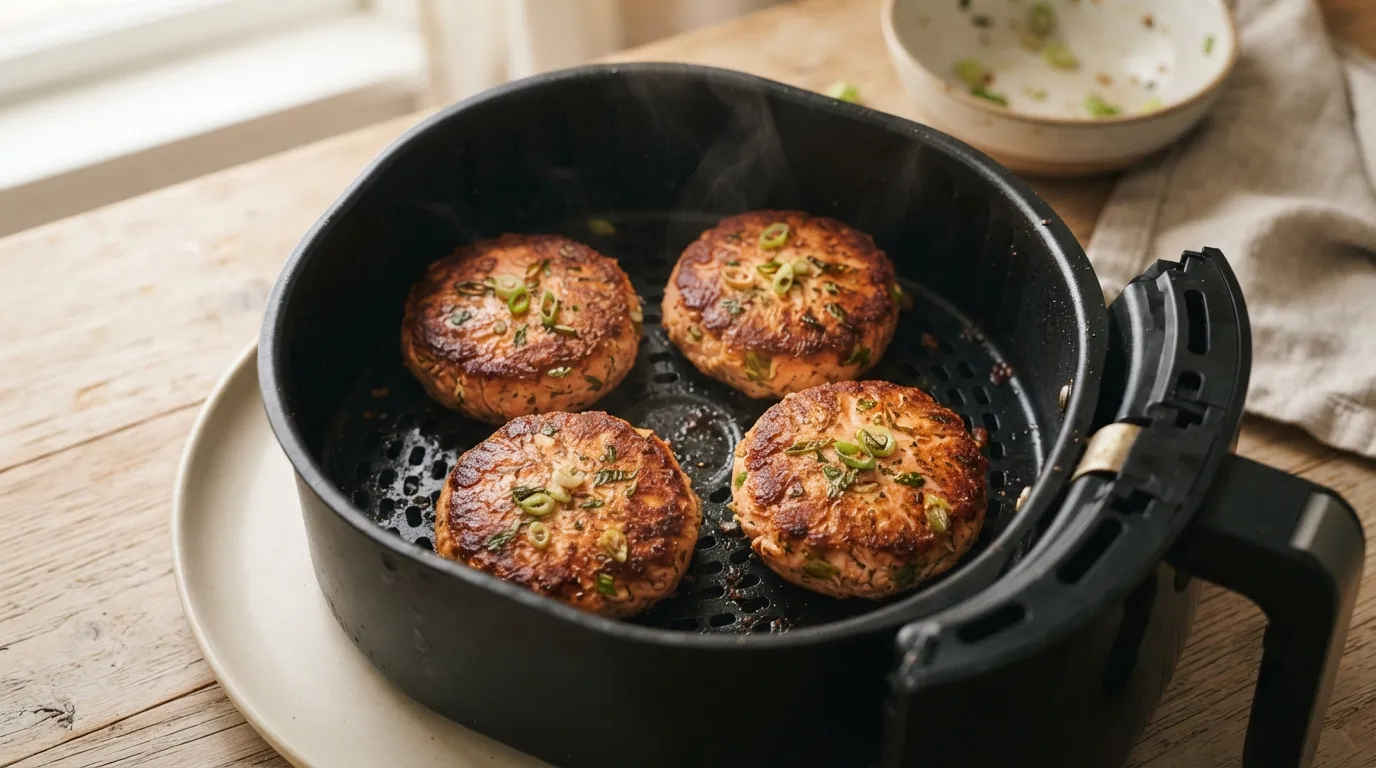
Temperature
375°F
190°C
Time
12 min
4 patties (one 14.75 oz can)
Safe internal
160°F
71°C · piping hot
Prep
25 min
Cook
12 min
Total
37 min
Salmon patties are a canned-salmon recipe - drained fish, egg and crumbs, mixed and shaped - and the basket suits them better than a skillet does: one careful turn with a spatula, rather than shallow-frying something fragile in a pan of hot oil. The thing worth knowing before you start is that the fish arrives already cooked, so the twelve minutes are not spent cooking salmon. They are spent setting the egg that holds the patty together and browning the outside, which is also why these are fragile going in and firm coming out.
Ingredients
Quantities for 4 patties (one 14.75 oz can) - the times on this page assume that much in the basket.
- 1 can (14.75 oz / 418g) pink or red salmon, drained
- 2 eggs, lightly beaten
- 3/4 cup panko breadcrumbs
- 3 scallions, finely sliced, plus a few extra to scatter
- 1 tsp Dijon mustard
- Zest of 1/2 lemon
- 2 tbsp dill, chopped - half through the mixture, half into the yogurt
- Salt and black pepper
- Oil spray, for both faces of the patties
- 1/4 cup plain yogurt, to serve
- Lemon wedges, to serve
How to air fry salmon patties
- Drain the salmon hard, pressing the liquid out against the lid, then tip it into a bowl and flake it with a fork, mashing the soft bones and skin through it as you go. Mix in the beaten eggs, the panko, the scallions, half the dill, the mustard, the lemon zest, salt and pepper, and keep going until a squeezed handful holds its shape. Shape four patties about three quarters of an inch thick, sit them on a plate and chill them for at least fifteen minutes, which is what makes them firm enough to handle. Spray or brush both faces with oil just before they go in. Stir the rest of the dill into the yogurt; that and the lemon wedges are for the table, along with the last of the scallion to scatter over.
- Preheat the air fryer to 375°F (190°C).
- Add the fresh salmon patties to the basket. Leave a finger's gap around each patty. They are fragile until the egg sets, and a crowded basket means lifting one to get at another.
- Cook for about 12 minutes, flipping them once at about 8 minutes rather than at the halfway mark.
- Check it has reached a safe internal temperature of 160°F (71°C) before serving.
Pro tip
Buy the can with the bones and skin in rather than the skinless, boneless one. Both disappear into the mixture as you flake it, the bones crushing under a fork without you noticing, and they are where nearly all of canned salmon's calcium sits - so the boneless can is the more expensive way to buy less. If the texture bothers you, break the bones up before the egg goes in rather than after.
How to tell when it's done
The tops should be deep golden and the patty should feel set rather than soft when you lift an edge with a spatula. The number that decides it is 160°F (71°C) in the middle, and it belongs to the egg rather than to the fish - the salmon came out of the can cooked. Go in from the edge with the probe held flat so the tip finishes in the centre of the patty rather than out the far side.
Safe internal temperature
Cook to 160°F (71°C) at the thickest point. An instant-read thermometer is the only reliable way to confirm it.
Air fryer salmon patties: the egg is the only thing holding them together
Canned salmon is cooked inside the sealed can, at around 240°F (116°C) under pressure - hotter than anything that happens in an air fryer, and held there long enough to soften the vertebrae to the texture of the flesh around them. By the time it reaches you its proteins are thoroughly and permanently set, and that has a consequence the recipes skip: the fish cannot help hold the patty together. Raw fish can. Chop or pulse fresh salmon and work it about, and the muscle protein turns tacky and glues the pieces to itself - it is the principle behind fish balls and fish cakes, and it is why recipes for fresh salmon burgers can honestly leave the egg out altogether and simply blitz a third of the fish into a paste to bind the rest. Nothing you do to canned salmon will produce that paste. Mash it for as long as you like and what you have is wet flakes.
So every bit of structure in a salmon patty is added, and the egg is most of it. That is worth reading next to our beef burgers page, because it is the same shape of food behaving in the opposite way. A beef patty is held together by its own protein and it contracts as that protein sets - hard enough that the page tells you to press a dimple into the middle so the burger finishes flat instead of domed. A salmon patty cannot dome. There is nothing left in it capable of contracting, so it sits exactly as flat as you shaped it. The same difference decides when to turn them. A burger has structure from the first minute and gains more with time; a salmon patty has none until the egg sets, and once it has, further minutes add dryness and nothing else. At the halfway mark the set shell is still thin and the middle still soft, so the patty flexes as it comes off the basket and that is where it breaks. Give it eight minutes of the twelve and the set layer is thick enough to carry the middle, and the second face still gets four minutes on the basket floor to colour - it has been sitting in a 375°F airstream the whole time and only needs finishing.
The third thing the egg does is glue the patty to the basket, and it does that at the same moment it does the useful work. Egg protein bonds readily to hot metal - it is why scrambled eggs weld themselves to a pan - and a patty laid straight onto a bare basket sets against it precisely where it touches. A skillet has a film of oil in between. The basket, unless you put one there, has nothing. It is also worse than a flat pan for a second reason: a perforated base means the patty is not resting on a surface but bridging the narrow strips of metal between the holes, so when you lift it, all of the tearing force is concentrated on the few strips it is welded to. Our cookies page asks for parchment against the same basket for a different reason - cookie dough is liquid at baking temperature and runs down into the holes, so what holds it there is mechanical, a set of little rivets. A salmon patty never flows anywhere. It is stuck chemically, flat against the metal it happened to touch. That is why the oil in this method goes onto the patties themselves rather than only into the basket, and why a perforated liner is worth using here. Put it in before the cook, not after - once egg has set against bare metal there is no releasing it, only scraping.
Converting from an oven recipe
If your recipe is written for a conventional oven, lower the temperature by about 25°F (15°C) and reduce the time by roughly 20% to land near 375°F for 12 minutes. Need a different starting point? Use the conversion calculator.
Air fryer salmon patties: FAQ
Are salmon croquettes and salmon cakes the same as salmon patties?
Close enough that this recipe makes all three - the differences are shape and regional habit rather than method. Salmon croquettes is the older name, and in some kitchens it means the mixture rolled into a log or a cone rather than pressed flat. Salmon cakes usually means the same mixture left a little coarser, closer to a crab cake. All three start from drained canned salmon bound with egg and crumbs, so the temperature, the timing and the handling on this page apply to each of them. Shape does move the clock: anything rolled thick rather than pressed to three quarters of an inch needs a few more minutes to bring the middle to 160°F (71°C), and it is the middle that decides, never the surface. The one that is genuinely a different dish is a salmon burger, which is normally built from fresh salmon rather than canned - and that changes what holds it together, which is what the section above is about.
Can you make air fryer salmon patties without egg?
You can, but you have to replace what the egg was doing rather than simply leave it out, because canned salmon brings no binding of its own. The substitutes that work are the ones that set or thicken when heated: a couple of tablespoons of mayonnaise, a few spoons of mashed potato, or flaxseed stirred into water and left to gel. What does not work is more breadcrumbs on their own - dry crumbs soak up moisture but they glue nothing, so the mixture gets stiffer to shape and no more likely to survive the turn. Whatever you use, chill the patties nearer half an hour than the fifteen minutes above, and turn them later rather than earlier. It also changes what the thermometer is for: the 160°F (71°C) on this page is the egg's figure, so with no egg in the mixture there is no raw ingredient left to make safe - the salmon was cooked in the can. Take them out when they are hot through and properly golden.
How long does it take to air fry salmon patties?
Air fry salmon patties at 375°F (190°C) for about 12 minutes, flipping them once at about 8 minutes rather than at the halfway mark. That's for 4 patties (one 14.75 oz can) in a single layer; adjust slightly for a fuller basket or a different model.
What temperature do you air fry salmon patties at?
Set the air fryer to 375°F (190°C). If you're converting an oven recipe, that's roughly 25°F (15°C) below the oven temperature, with the time cut by about 20%.
Do I need to preheat the air fryer for salmon patties?
A 2-3 minute preheat gives the most accurate timing and the best browning, but it isn't essential - if you skip it, add a minute or two to the cook time.
What's the safe internal temperature for salmon patties?
Cook salmon patties to a safe internal temperature of 160°F (71°C), measured at the thickest point with an instant-read thermometer. Cooking time is a guide; internal temperature is what confirms it's safely done.