Air Fryer Bratwurst
Temperature
350°F
175°C
Time
14 min
4 brats (about 1 lb)
Safe internal
160°F
71°C · piping hot
Prep
2 min
Cook
14 min
Total
16 min
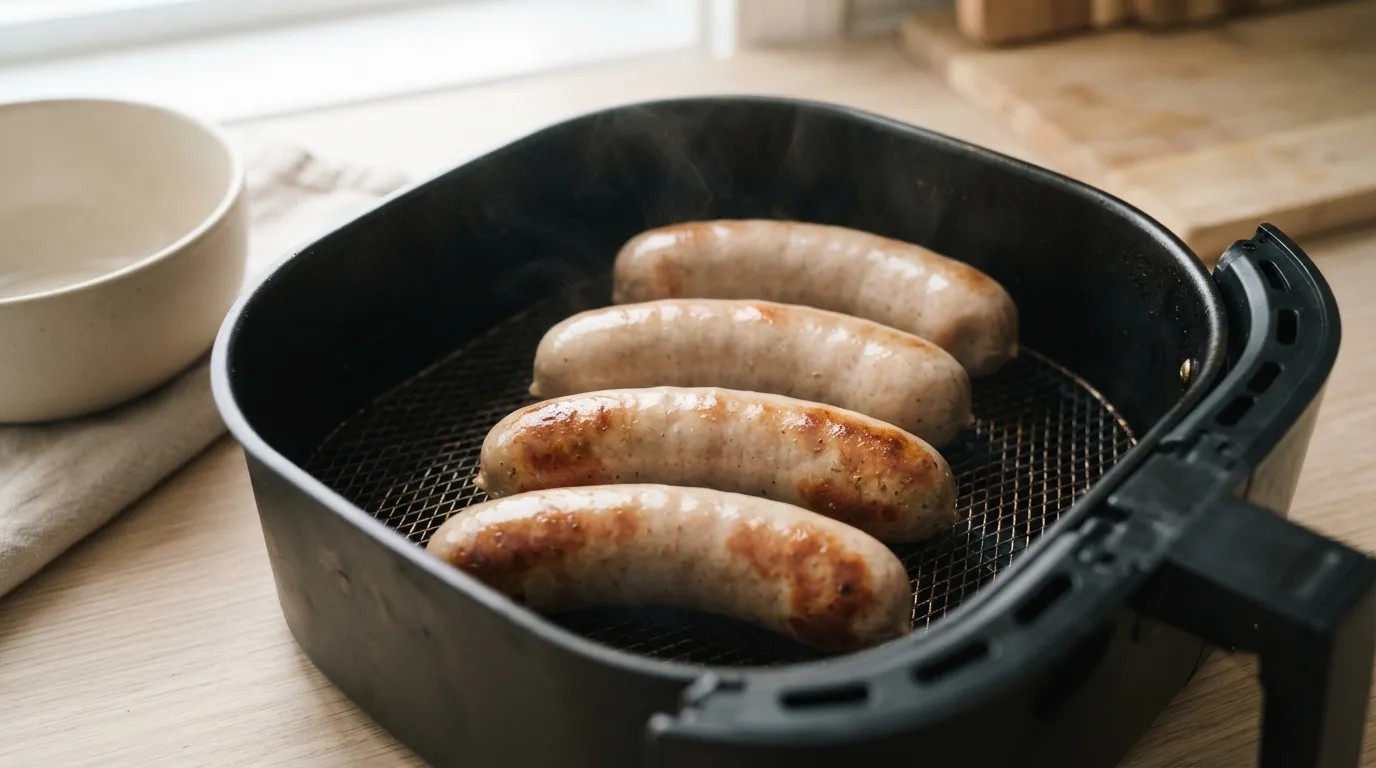
Air fry bratwurst at 350°F (175°C) for about 14 minutes, turning them over at 7, and take them out when the middle reads 160°F (71°C). Keep the setting down there rather than at the 390°F the packet gives for an air fryer: a raw brat has to stay in until its centre is safe, and at 390°F the casing is finished stretching well before that.
Ingredients
Quantities for 4 brats (about 1 lb) - the times on this page assume that much in the basket.
- 4 fresh bratwurst links (about 1 lb)
- 4 split brat rolls, to serve
- 1 cup sauerkraut, drained, to serve
- 2 tbsp yellow mustard, to serve
How to air fry bratwurst
- Nothing is done to the brats themselves. They go in as they come out of the pack, with no oil and no seasoning - a raw bratwurst is already seasoned inside its own casing and carries enough fat to colour without help, and anything rubbed on the outside is one more thing drying onto a skin you are trying to keep intact. The two minutes are for the rest of it: split the rolls and drain the sauerkraut well before the brats go in, because these are worth eating straight out of the basket and the mustard is the only thing that can wait.
- Preheat the air fryer to 350°F (175°C).
- Add the fresh bratwurst to the basket. Lay them in a single layer with a finger's width between them, and do not let two links rest against each other along their length. Four brats want roughly a 9-inch basket floor; six in the same space take longer to reach 160°F, and on this food the extra minutes land on a casing that is already tightening. Cook six in two batches rather than one.
- Cook for about 14 minutes, turning them over at 7 minutes.
- Check it has reached a safe internal temperature of 160°F (71°C) before serving.
Pro tip
Take the reading in through one end of the link rather than through the side. A brat is a cylinder, so the coldest point is on its long axis, halfway along - push an instant-read probe in at the twisted end, along the sausage, until the tip is about level with the middle of the link, and that is where it lands. It also keeps the hole out of the side wall, which is the part under tension and the part that splits; the ends are gathered casing and are not holding the sausage together the same way. Worth the small awkwardness of steadying a hot link with tongs to do it. The common advice to keep the thermometer out of them altogether, so as not to let the juices out, has the right worry and the wrong solution.
How to tell when it's done
160°F (71°C) in the centre of the thickest link is the figure. It is USDA's number for raw ground pork rather than anything particular to this recipe, and it is the number printed on the pack. It is also not one you can swap a cue for, because every visible sign on a brat arrives early: the link tightens, shines and picks up dark speckling on the faces that met the basket floor well before the middle is there, so one that looks ready at nine minutes can still be short at the core. Take the reading. The outside is still worth watching, but for trouble rather than for doneness: the first small break anywhere in a casing tells you the surface has got ahead of the middle, and the answer to that is to drop the setting to 325°F (165°C) for whatever time is left rather than to pull the brats out early. The figure does not move because a casing gave way.
Safe internal temperature
Cook to 160°F (71°C) at the thickest point. An instant-read thermometer is the only reliable way to confirm it.
Air fryer brats split because the casing finishes before the middle does
Two things are going on inside a bratwurst and they finish at different moments - our Tyson nuggets page calls them two clocks, one running on the surface and one running on how thick the piece is, and that is the right way to look at a bratwurst. What is different here is what happens when the first clock runs out. Our chicken sausage page explains the casing itself: it is collagen, it contracts as it heats and it tightens further as it dries, while the filling inside it is turning water to vapour and asking for more room, so a split is where the two curves cross. The advice that follows there is to stop when the casing goes taut and glossy, and you can, because those links are sold fully cooked and were safe to eat before they went in. A raw brat at that same moment is nowhere near finished. Its middle is still well short of 160°F, with minutes to run, on a casing that is already at the end of what it can stretch.
The clearest evidence that this, rather than the clock, is the real constraint is printed on the packet. Johnsonville's Original Brats carry four sets of directions and all four end at the same 160°F, so what separates them is not a disagreement about how hot to get the sausage. The grill direction is medium-low, covered, fifteen to twenty minutes. The stovetop direction browns the links for about five minutes, then adds half a cup of water, covers the pan and simmers them for twelve. The oven direction is 425°F for nineteen to twenty-one minutes. The air fryer direction is 390°F for ten to eleven.
Read as a set rather than as four separate recipes, those numbers say something none of them says on its own. The oven direction is the hottest on the packet and also the longest, which is less of a contradiction than it looks: moving air hands heat over far more efficiently than the still air of a big cavity, which is the point our conventional oven conversion page turns on, so a fan-driven basket brings the outside of a sausage up to temperature sooner than a hotter oven does. Our Stouffer's lasagna page sets the limit of that in general terms - a fan can only accelerate what happens at the surface, and from there the heat travels inwards at a rate set by the food's own thickness and how well it conducts, which no amount of air movement changes. A bratwurst is thick enough for both halves to count. The casing gets close to the air temperature within the first couple of minutes and then sits there for the rest of the cook, while the middle climbs on its own schedule. So the ten minutes is honest - the middle really does get there. But three of those four methods put something between the heat and the casing, a low flame, a lid and half a cup of water, or a still cavity, and the air fryer direction puts nothing at all, at the highest surface temperature of the lot.
That leaves fewer moves than usual, because a brat closes the three answers this site normally gives when the outside finishes ahead of the inside. You cannot flatten it: our chicken breast page beats a wedge of meat down to an even three-quarters of an inch, and the equivalent here is opening the casing, which is the failure rather than the fix. You cannot stop early and let it coast, because 160°F (71°C) on raw ground pork is not a figure you negotiate with. And you cannot simply ignore the outside and cook to the thermometer, which is the standard answer to a colour that arrives too soon, because on this food the outside does not merely go too dark - it lets go, and what it lets go of is the fat and water the sausage was for. What is left is the dial. Our Tyson nuggets page already makes that trade for the other reason - a gentler 375°F rather than a blast at 400°F, so the middle has time to get there before the outside overshoots - and on a nugget that came out of the factory cooked, overshooting costs you a dry one. Here the same move is not a refinement. It is the only lever the food leaves you, and what it is buying is not texture but an intact sausage. At 350°F (175°C) the casing spends the whole cook further from the point where it gives, the filling makes vapour more slowly, and the middle still reaches 160°F - four minutes later. Those four minutes are the cheapest thing on this page: they are added to the clock that cannot be hurried and taken off the one that ends in a burst sausage.
Converting from an oven recipe
If your recipe is written for a conventional oven, lower the temperature by about 25°F (15°C) and reduce the time by roughly 20% to land near 350°F for 14 minutes. Need a different starting point? Use the conversion calculator.
Air fryer bratwurst: FAQ
Does poking holes in brats stop them bursting in an air fryer?
It does reduce the bursting, and it costs you more in a basket than it would anywhere else. A hole lets pressure out and a pricked link really is less likely to split. Our chicken sausage page runs the same argument and then declines the trade, because on a lean chicken link what leaves through the hole is mostly water. A bratwurst is the case that page leaves open: it is a fatty pork sausage, so a good deal of what leaves is rendered fat, and the trade is worth pricing properly rather than waving through. In a skillet it is close to even. The fat comes out, lands in the pan, stays hot and is still underneath the sausage at the end. A basket is the one place that does not happen - our Spam page spends its whole argument on it: the floor is perforated, so fat that leaves goes straight through into the drawer and nothing brings it back. The hole you made to save the casing empties the sausage into a tray you are about to wash. So the answer is the one the section above arrives at by a different route: deal with the pressure at the dial, where it costs you nothing but four minutes, rather than at the casing, where it costs you the thing you were protecting.
Should you simmer brats in beer before air frying them?
It works, and it is worth being clear about what it does, because it is the one move that takes this problem apart rather than managing it. Johnsonville's own stovetop direction is a version of it - brown the links, then add half a cup of water, cover the pan and simmer for twelve minutes - and beer brats are the same idea with the liquid changed and, usually, the order reversed. Water cannot take a casing past 212°F (100°C) and cannot dry it out, so a simmer brings the middle up to 160°F (71°C) in a medium where the outside is losing nothing. What comes out is, as far as this page is concerned, a cooked sausage that needs colour and nothing else - which is the situation our chicken sausage page describes, and a basket is very good at it. Six to eight minutes at 375°F (190°C), turned once, and take them out on the colour. That is not this page changing its mind about the thermometer - it is the simmer moving the thermometer's job earlier, so check the middle in the pan before the links go anywhere near the basket, and 160°F (71°C) is still the figure. As for the beer, keep expectations modest: a casing is a barrier and twelve minutes is not long, so it does far more for the onions in the pan and for the outside of the link than it does for the meat inside it.
How long does it take to air fry bratwurst?
Air fry bratwurst at 350°F (175°C) for about 14 minutes, turning them over at 7 minutes. That's for 4 brats (about 1 lb) in a single layer; adjust slightly for a fuller basket or a different model.
What temperature do you air fry bratwurst at?
Set the air fryer to 350°F (175°C). If you're converting an oven recipe, that's roughly 25°F (15°C) below the oven temperature, with the time cut by about 20%.
Do I need to preheat the air fryer for bratwurst?
A 2-3 minute preheat gives the most accurate timing and the best browning, but it isn't essential - if you skip it, add a minute or two to the cook time.
What's the safe internal temperature for bratwurst?
Cook bratwurst to a safe internal temperature of 160°F (71°C), measured at the thickest point with an instant-read thermometer. Cooking time is a guide; internal temperature is what confirms it's safely done.