Air Fryer Spam
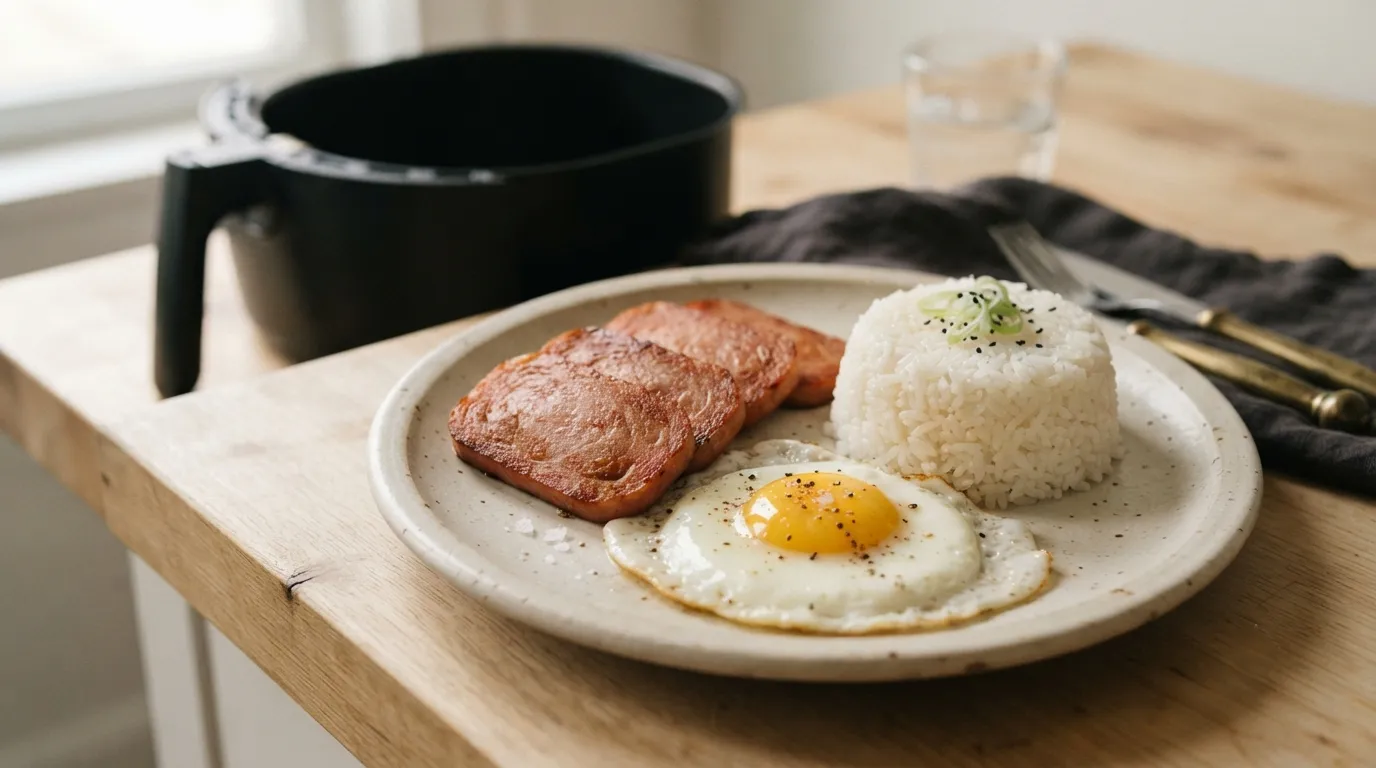
Temperature
375°F
190°C
Time
12 min
6 slices (one 12 oz can)
Heat through to
Piping hot
cooked right through
Prep
5 min
Cook
12 min
Total
17 min
A can of Spam is already cooked - the sealed can is cooked under pressure at the factory, which is why it keeps for years on a shelf and is edible cold - so nothing in the basket is being made safe and the whole twelve minutes goes on the outside of the slice. Every recipe for this says the same thing next: Spam is fatty enough that it needs no oil, because the fat renders out and bastes the slices as they cook. In a skillet that is exactly what happens. In a perforated basket it is close to the opposite, and the same pages give it away a few paragraphs later when they warn you not to cut the slices too thin or they come out dry.
Ingredients
Quantities for 6 slices (one 12 oz can) - the times on this page assume that much in the basket.
- 1 can (12 oz) Spam Classic, cut into 6 slices
- Steamed white rice with sliced spring onion and black sesame seeds, to serve
- A fried egg, with flaky salt and black pepper, to serve
How to air fry spam
- Get the rice on first if you are having it, and the egg after the Spam rather than before - the slices are twelve minutes and both of those are quicker. Run a knife around the inside of the can, turn the block out onto a board and cut it into six even slices. Six is what the can's own label calls six servings, and it is deliberately thicker than the quarter-inch a skillet recipe asks for, for the reason set out below. The block is soft enough to squash under a knife, so use a long thin blade and draw it through in one stroke rather than pressing down, or you get six wedges instead of six slices. Nothing goes on the slices themselves - no oil, no seasoning, and nothing needs to. The spring onion, the sesame, the salt and the pepper all belong to the rice and the egg.
- Preheat the air fryer to 375°F (190°C).
- Add the fresh spam to the basket. Lay the slices flat in a single layer with a gap between each one, and do not let two of them overlap. Everything this cook achieves happens on the two flat faces, so a face with another slice sitting on it has been taken out of the recipe. Six go flat in one layer in most 5-6 quart baskets; if yours is smaller, run them in two batches rather than shingling them.
- Cook for about 12 minutes, turning the slices over at 6 minutes so both faces get their spell against the metal.
Pro tip
Skip the paper towels. Draining fried Spam on kitchen paper is a habit carried over from the skillet, where the slice really is lifted out of a pool of its own fat and drips; a slice out of a basket has had gravity pulling that fat away from it for twelve minutes, and the little that is left on the face is the part doing the browning. The drawer underneath is the thing that wants emptying - pour it off before a second batch goes in.
How to tell when it's done
You are reading colour and nothing else, because there is no interior to reach. Twelve minutes at 375°F (190°C) with one turn takes the slices to a deep, even gold, the edges a shade darker than the middle of the face, and a surface that has gone matte rather than wet-looking. Lift one on the tongs and it should hold itself flat rather than sagging over them; a slice that still folds has a face that has not set. If the edges are already brown while the middle of the face is still pale, the dial was too high rather than the time too short: an edge has fast air on more sides of it than the middle of a face does, so it always runs ahead, and the lower the temperature the smaller that gap is by the time the face catches up. Spam browns sooner than a plain pork chop would in any case - it is cured, and sugar and modified potato starch are both on the ingredient list. Take them out a shade short of what you want, because a hot slice carries on darkening for a minute on the plate.
Air fryer Spam: the fat it renders is the frying medium, and the basket is where it goes
Basting means putting fat back onto the food, so it is worth following where the fat actually goes. In a pan it has nowhere to be except the pan: it collects, it climbs the sides of the slice, it stays hot, and there is more of it at minute eight than there was at minute three - a slice in a skillet finishes by shallow-frying in a pool it made itself. In a basket the same fat renders at the same rate and falls straight through the perforations into the drawer, and none of it comes back. Our salmon fillet page already says this about a fillet's skin: the rendered fat drops through into the drawer rather than pooling under the fish, where on a solid pan it would go on frying the underside. So from the same starting slice, the amount of fat in contact with the meat rises through a pan cook and falls through a basket one. That is not a difference of degree. It is two processes wearing the same recipe.
Which raises the question of what does brown the underside of a Spam slice, and the answer is the thing it is lying on. This site is consistent about it: our brussels sprouts page has a flat face against the perforated basket browning the way it would in a hot pan, because metal conducts heat far better than air does, and our texas toast page calls the side on the basket the face with the least to worry about. A Spam slice is nothing but two flat faces, so the one that is down has a route for heat that the one pointing up does not have at all. That is what the turn at six minutes is for. It is not there to even out the colour and it is not a tidying-up step - each face gets one spell on the metal and one spell in nothing but moving air, and six minutes is where they swap. Leave a slice unturned and you get one good face and one that has only been dried.
Our beef burgers page watches the same fat leave and reaches the opposite conclusion, which is why the two are worth reading together. A beef patty renders a great deal of fat, in a skillet it sits in the pool and comes out greasy, and losing it through the perforations is called a fair swap there. It is a fair swap there, because a burger's objective is inside it - 160°F right through - and the rendered fat is a by-product on the way to that. Here there is no inside. The objective is entirely the two faces, the fat was the only medium this dish was ever going to be cooked in, and the appliance is built to get rid of it. None of which makes the basket the wrong tool: it works on both faces at once, without a pan of hot oil to turn, without spitting and without standing over it, which is why people use it.
It does mean you are drying the slice at least as much as frying it, and that prices two instructions the recipe pages hand out without a reason. Cut the slices thicker than a skillet recipe asks for, so there is still a soft middle underneath two dried faces - that is the whole content of the warning not to slice them too thin, and it is why this page divides the can six ways rather than twelve. And stop when the colour arrives rather than pushing on for the lacquered, blistered face a pan gives you. That face is built by fat held against meat, and once the fat is through the holes the extra minutes are not building it. They are only taking water out.
Converting from an oven recipe
If your recipe is written for a conventional oven, lower the temperature by about 25°F (15°C) and reduce the time by roughly 20% to land near 375°F for 12 minutes. Need a different starting point? Use the conversion calculator.
Air fryer spam: FAQ
Can you eat Spam without cooking it?
Yes. It is cooked inside the sealed can under pressure, which leaves it commercially sterile - that is why an unopened can keeps for years at room temperature, and why it is safe eaten cold straight out of the tin. It is also the reason this page carries no safe internal temperature where the rest of our meat pages do: there is no pathogen to kill and therefore no figure to hit, so the basket is a preference rather than a requirement. Once the can is open that stops being true and it becomes an ordinary opened meat product, so wrap it or decant it and refrigerate it - USDA gives opened canned meat three to four days in the fridge.
Can you make Spam musubi in the air fryer?
Yes, and the basket handles the Spam far better than it handles the glaze. Crisp the slices as this page describes, then brush the soy-and-sugar glaze on for the last minute or two rather than before they go in. Our carrots page makes the same point about honey and our meatloaf page about ketchup: at these temperatures a sugar glaze is dark and bitter long before the thing underneath it is ready, and here it would be sitting on a face that is already browning early on its own. Slices cut for musubi are usually a little thinner than the six this page asks for, so they sit flat against the rice - take a minute or two off the time if you cut them that way, and expect a firmer slice, which is the trade the section above describes. The rice and the nori are assembled off the machine once the Spam is cool enough to handle.
How long does it take to air fry spam?
Air fry spam at 375°F (190°C) for about 12 minutes, turning the slices over at 6 minutes so both faces get their spell against the metal. That's for 6 slices (one 12 oz can) in a single layer; adjust slightly for a fuller basket or a different model.
What temperature do you air fry spam at?
Set the air fryer to 375°F (190°C). If you're converting an oven recipe, that's roughly 25°F (15°C) below the oven temperature, with the time cut by about 20%.
Do I need to preheat the air fryer for spam?
A 2-3 minute preheat gives the most accurate timing and the best browning, but it isn't essential - if you skip it, add a minute or two to the cook time.