Air Fryer Italian Sausage
Temperature
350°F
175°C
Time
14 min
4 links (about 1 lb)
Safe internal
160°F
71°C · piping hot
Prep
None
Cook
14 min
Total
14 min
Air fry Italian sausage at 350°F (175°C) for about 14 minutes, turning the links over at 7, and take them out when the middle reads 160°F (71°C). Those are our bratwurst page's settings and deliberately so - it is the same raw pork link in the same tightening casing, and the 400°F most recipes reach for finishes the outside long before the middle is safe.
Ingredients
Quantities for 4 links (about 1 lb) - the times on this page assume that much in the basket.
- 4 fresh Italian sausage links (about 1 lb)
How to air fry italian sausage
- Preheat the air fryer to 350°F (175°C).
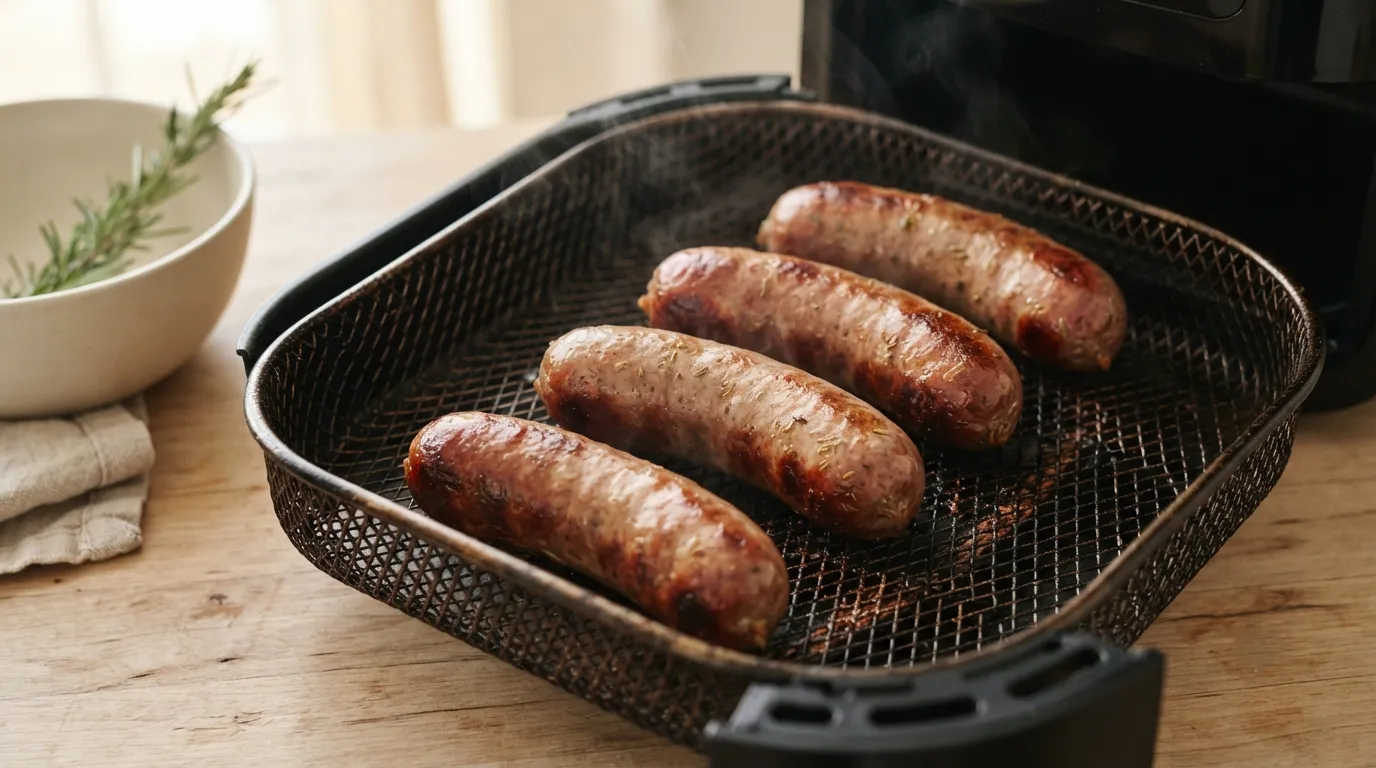
- Add the fresh italian sausage to the basket. Lay the links in a single layer with a finger's width between them - four fit a 9-inch basket floor comfortably. Nothing goes on top of them to make room, peppers and onions included; that is the one arrangement this page argues against, and the section below says why. Six links want two batches.
- Cook for about 14 minutes, turning them over at 7 minutes.
- Check it has reached a safe internal temperature of 160°F (71°C) before serving.
Pro tip
These are usually on their way somewhere else - sliced into pasta, split into a sub, cut into coins for a tray bake - so give them two or three minutes on the board before the knife goes in. A link cut open the moment it leaves the basket loses a good deal of what is inside it onto the board, and the same link left a couple of minutes cuts into coins that hold together. It is the one instruction on this page with nothing to do with the air fryer, and it is the one most often skipped.
How to tell when it's done
160°F (71°C) in the middle of the thickest link, and the reason to reach for a probe rather than the clock is that the words on the pack do not tell you what is in it. 160°F is USDA's figure for raw ground pork, which is what a plain Italian sausage is; the chicken and turkey versions carry the same seasoning under the same two words and want 165°F (74°C). Outside, the casing pulls in against the filling and colours unevenly, darkest along the two strips that lay against the basket floor. That colour arrives well before the middle is safe - our bratwurst page sets out at length why the outside of a raw link finishes first - so read it as the cook going to plan rather than as the signal to stop.
Safe internal temperature
Cook to 160°F (71°C) at the thickest point. An instant-read thermometer is the only reliable way to confirm it.
Italian sausage in the air fryer: peppers and onions go around the links, not on top of them
Italian sausage is rarely the whole of dinner, and the thing it is most often cooked with is a basket of sliced peppers and onions. The published methods stage that two opposite ways. America's Test Kitchen puts the vegetables in first at 350°F for eight minutes, stirs them, and then arranges the sausages on top of them. Cook the Story does the reverse - links in first, vegetables piled over them - and is the only one of the two to give a reason: "if you put the veggies under the sausage, or around them, they do get too oily with the fat from the sausage cooking." One dish, opposite arrangements, and the single stated reason for either is grease.
Grease is the wrong thing to be arranging around, because a basket has no bottom. Sitting in fat is a pan problem: our Spam page follows the same fat through both appliances and finds that in a skillet it collects, climbs the sides and is still there at the end, while in a basket it falls straight through the perforations into the drawer and none of it comes back. Our page on putting water in an air fryer recommends a couple of tablespoons of it down in that drawer when you cook sausages, precisely because that is where the grease all ends up and where it smokes. So vegetables underneath the links are not sitting in anything. They get fat passing over them on its way down, which is a few seconds of contact rather than a bath - and in a skillet, that contact is the entire dish. The exception is worth knowing about: a few models are sold with a solid-bottomed insert rather than a perforated basket, and in one of those the drainage never happens, the fat pools where it lands and the warning is exactly right again.
What the order genuinely decides is which of the two foods is held against the other one's water. A bell pepper is about nine parts water in ten and gives it up steadily for the whole cook; our own peppers page tells you to toss the strips halfway so they colour instead of steaming. A casing wants the reverse of that, and our roasted potatoes page puts the rule in numbers: a wet surface cannot brown, because evaporation pins it near 212°F (100°C) while the browning reactions need closer to 285°F (140°C). Our chicken sausage page adds the half that belongs to a link - a drying casing is a tightening casing, and that drying is what gives you the colour at all. So pile wet vegetables over the links and the problem is not mainly that the casing is shaded: moving air goes round corners and down into recesses, as our frozen waffles page shows. It is that the casing is pressed against something wet, which is exactly why our frozen meatballs page keeps the marinara in a pan rather than in the basket. The recipe that stacks them that way contains its own correction: at eight minutes it stops you, has you stir the vegetables and "re-arrange the peppers and onions around the sausages now that they're softer, exposing the sausages more so they can brown well."
The two halves are also not the same length of cook, and our own chart prices them: pepper strips are eight minutes at 375°F (190°C), and these links are fourteen at 350°F (175°C). So the arrangement resolves itself. Put the sausages in on their own, and when you turn them at seven minutes tip the peppers and onions in around them rather than over them - four links and about two peppers' worth of strips is what a 9-inch floor takes, and more than that is two batches. Some contact is unavoidable once the gaps are full, and the paragraph above says what it costs: wherever a strip ends up leaning against a link, that stripe stays pale. A stripe is a great deal cheaper than the whole upper face. Seven minutes at 350°F leaves the vegetables a little firmer than our peppers page's eight at 375°F, so put them in at five if you like them slack. The one thing you cannot get back is the other half of the skillet version: the fat that would have been cooking those peppers went through the floor while the links were in there on their own, and it is in the drawer. Season them as though they were a tray of roast peppers, because in a basket that is what they are.
Converting from an oven recipe
If your recipe is written for a conventional oven, lower the temperature by about 25°F (15°C) and reduce the time by roughly 20% to land near 350°F for 14 minutes. Need a different starting point? Use the conversion calculator.
Air fryer italian sausage: FAQ
Is chicken or turkey Italian sausage cooked the same way?
The seasoning is the same and the finishing figure is not. "Italian sausage" names a spice mix rather than an animal, so the identical two words go on pork, chicken and turkey links, and the safe internal temperature does not follow the words - it follows what was ground. Pork is 160°F (71°C), which is the number on this page; anything ground from poultry is 165°F (74°C). The settings here still work, but the target moves five degrees further on, so expect it to want another minute or two and go by the probe rather than the clock. One other thing changes with it: a good deal of what is sold as Italian-style chicken sausage is fully cooked and smoked rather than raw, in which case the basket is browning a link that was already safe to eat - our chicken sausage page is the one to follow for those, and it explains why a lean link punishes a higher setting.
Can you air fry bulk Italian sausage with the casings off?
You can get it cooked and a skillet will do it better, which is worth saying plainly because a lot of this sausage is sold loose. Crumbled meat has no shape to hold it above the perforations, so the smaller pieces drop through onto the drawer, and a solid tin or an unperforated liner stops that by also stopping the drainage - which is the trap our meatloaf page describes for a loaf pan, and crumbles have far more surface to lose to it than a loaf does. The bigger loss is the browned residue: a skillet leaves it stuck to the pan, which is where the sauce is built from, and a basket leaves it in a drawer you are about to wash. Where the basket does earn its place with this sausage is with the casing still on: a whole link browns, and the casing holds the fat against the meat long enough for it to be worth something. Loose meat in a basket has neither.
How long does it take to air fry italian sausage?
Air fry italian sausage at 350°F (175°C) for about 14 minutes, turning them over at 7 minutes. That's for 4 links (about 1 lb) in a single layer; adjust slightly for a fuller basket or a different model.
What temperature do you air fry italian sausage at?
Set the air fryer to 350°F (175°C). If you're converting an oven recipe, that's roughly 25°F (15°C) below the oven temperature, with the time cut by about 20%.
Do I need to preheat the air fryer for italian sausage?
A 2-3 minute preheat gives the most accurate timing and the best browning, but it isn't essential - if you skip it, add a minute or two to the cook time.
What's the safe internal temperature for italian sausage?
Cook italian sausage to a safe internal temperature of 160°F (71°C), measured at the thickest point with an instant-read thermometer. Cooking time is a guide; internal temperature is what confirms it's safely done.