Air Fryer Fry Bread
Temperature
375°F
190°C
Time
8 min
2 breads (5-inch)
Heat through to
Piping hot
cooked right through
Prep
20 min
Cook
8 min
Total
28 min
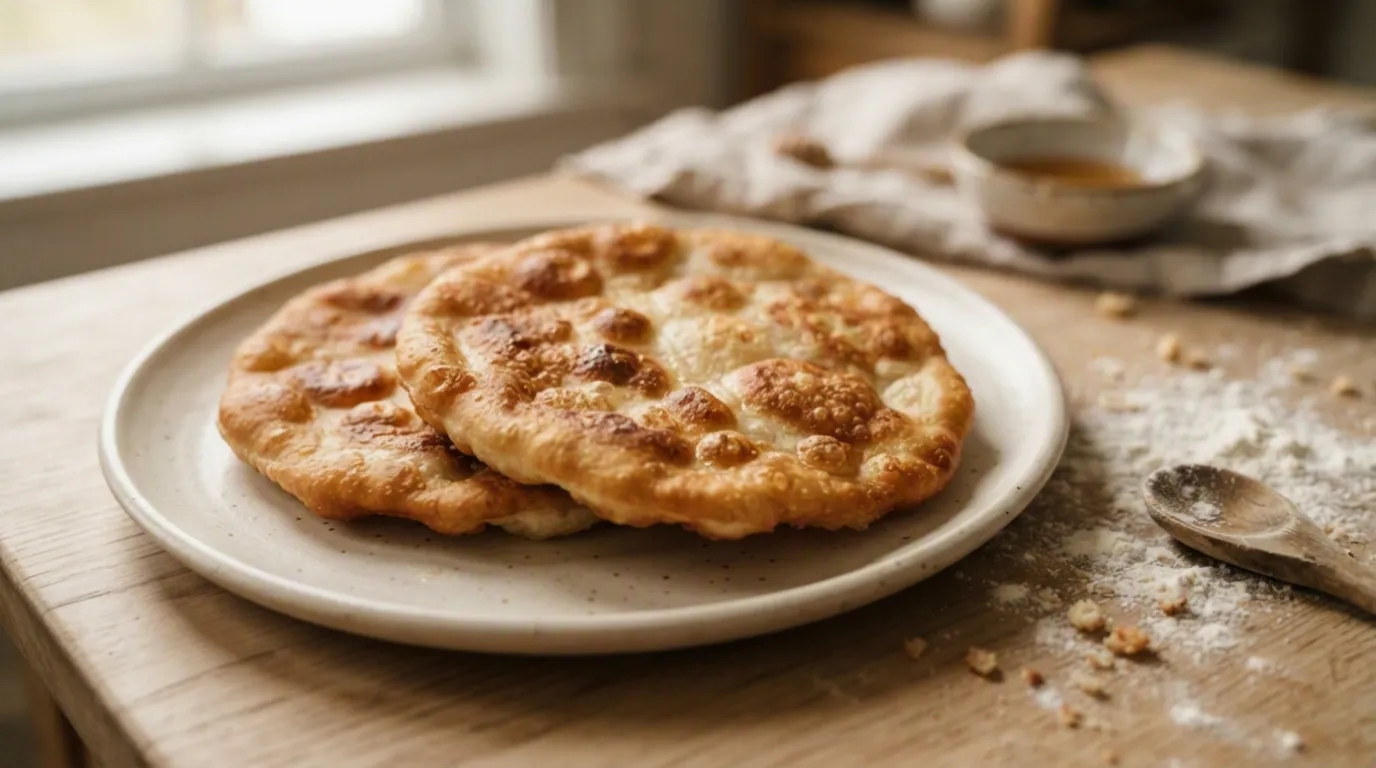
Air fry fry bread at 375°F (190°C) for about 8 minutes, turning the rounds over at 4, with both faces brushed with oil. Roll them a scant quarter-inch thick and give each one clear space in the basket. What comes out has fry bread's dough, its leavening and its flavour, in a flat gold round rather than the inflated pocket a pan of oil gives you - and that is not something a different technique fixes. The puff belongs to the oil, for the reason set out below.
Ingredients
Quantities for 2 breads (5-inch) - the times on this page assume that much in the basket.
- 1 cup (125 g) all-purpose flour, plus a little for rolling
- 1 1/2 tsp baking powder
- 1/2 tsp salt
- 6 tbsp warm water
- 1 tbsp neutral oil, for brushing
How to air fry fry bread
- Whisk the flour, baking powder and salt together, pour in the warm water and stir until it comes together as a soft, slightly sticky dough - about a minute, and no kneading past that. Cover it and leave it 10 minutes; straight from the bowl it fights the rolling pin and springs back to twice the thickness you rolled it to. Cut it in two and roll each half out on a lightly floured counter to about 5 inches across and a scant quarter-inch thick, working for an even round rather than a thick middle, and leave it whole - no hole or slit through the centre. Sweep the loose flour off both faces and brush them with the oil just before they go in.
- Preheat the air fryer to 375°F (190°C).
- Add the fresh fry bread to the basket. Lay them flat with a clear gap between them and do not let two rounds overlap. Two 5-inch breads want roughly a 9-inch basket floor to sit properly apart; in a smaller or oval basket, cook one at a time rather than shingling them. A second batch takes the same eight minutes.
- Cook for about 8 minutes, turning them over at 4 minutes.
Pro tip
The flour you roll on matters more here than it does in a pan. In hot oil that surface dust never survives - it fries straight into the crust and you never see it again. Nothing in a basket is going to take it up, so whatever is left after rolling stays on the outside as a pale floury bloom that tastes raw, and the oil brushed on over it sticks it down rather than absorbing it. So use as little on the counter as the dough will let you get away with, and take what is left off dry.
How to tell when it's done
There is no puff to read here, so the cues are colour and the middle. Both faces want to be gold with a few darker blisters, dry to the touch rather than tacky, and noticeably deeper where the dough lay flat against the basket than where it sat away from it. Then tear one open and look at the middle, which is the only test that settles it. A finished bread is dry and open the whole way across; a narrow grey line down the centre means the middle is still dough, and the answer to that is another minute or two at 375°F (190°C) rather than a hotter setting - on a quarter-inch round, the outside is never the part that is behind.
Air fryer fry bread comes out flat, and a hotter setting will not change it
The puff is the point of fry bread. A round of dough goes into the oil and inflates into a hollow, blistered pillow you tear open, and nobody disputes why: the baking powder gives off carbon dioxide, the dough's own water turns to steam, and steam takes up something like seventeen hundred times the room the water did. All of that is published and all of it is just as true in a basket - same dough, same leavening, 375°F either way. Yet it comes out flat, and the explanation offered for that is either that the round was rolled too thin or that the machine was not hot enough. Both are easy to test and neither survives it. Roll it thicker and you get a thicker flat bread; run it hotter and you get a darker one.
The dough's water has two ways out, and only one of them lifts anything. It can leave through the surface as vapour, steadily, from the moment the outside is warm enough to give it up. Or it can boil inside a round whose outside has already gone rigid, in which case it has nowhere to be and pushes the two faces apart. Which of those happens is not settled by how hot the dough gets. It is settled by whether the outside sets before the inside reaches 212°F (100°C) - and that is a question about how fast heat crosses into a surface, not about how much heat is available. A liquid in full contact with the dough moves heat into that surface roughly an order of magnitude faster than moving air can, so oil shuts the first exit within seconds, while the middle is still cool; by the time the middle boils there is one way out and it is straight up. Moving air cannot shut that door in time at any setting the bread survives - it reaches its own limit, a scorched face, long before it reaches the speed oil starts at. So the first exit stays open for all eight minutes, the water leaves as fast as it is made, and there is never a moment when a sealed round is full of vapour.
This site has already met the same fact from the other side. Our buffalo cauliflower page explains that a deep fryer sets a batter in seconds while moving air takes far longer, which is why a pourable batter has time to run down a floret and drip through the basket before anything holds it. Same physics, opposite loss: there the slow set costs you a coating on the outside, and here it costs you a pocket on the inside. That is worth saying plainly, because it makes this a ceiling rather than a fault. There is no version of the method that gets the pillow back, and both of the fixes people reach for take you further from it.
Two pieces of standard fry bread technique stop earning their place once you accept that. The first is the hole. Most recipes have you press a dimple or poke a fork through the middle, and in oil they are right to - a round that inflates unevenly cooks unevenly, and the hole is how you steer it. Here there is nothing to steer, so the hole is only a hole: a thin exposed edge in the middle of the bread that dries and stiffens ahead of everything around it. The second is the shaping. Fry bread is traditionally pulled and patted out by hand, thicker in the middle than at the rim, and in oil that unevenness matters less than you would think, because the round stretches as it inflates and the thick part thins with it. Nothing stretches in a basket. Whatever you leave in the middle has to cook through from both faces at the pace the dough conducts, so roll it, and roll it even - and rolled to a scant quarter-inch, eight minutes is enough. The ten minutes most air fryer versions give is two more minutes of drying a bread that was already done.
Converting from an oven recipe
If your recipe is written for a conventional oven, lower the temperature by about 25°F (15°C) and reduce the time by roughly 20% to land near 375°F for 8 minutes. Need a different starting point? Use the conversion calculator.
Air fryer fry bread: FAQ
Can you make frybread in an air fryer without any oil?
You can, and it will bake through perfectly well - but what you get is a flatbread rather than a fry bread. The tablespoon in this recipe is not frying anything; there is nowhere near enough of it for that. It is doing two smaller jobs. It wets a dry, floury surface so that heat meets dough rather than dust, which is most of the difference between gold at eight minutes and chalky beige at twelve. And it is the only fat anywhere in the recipe, so it carries all of the richness the original gets from the pan - a bare-baked round is noticeably drier in the mouth and stiffens faster as it cools. If you are cutting the oil down rather than cutting it out, brush it rather than spray it: a thin complete film on each face is worth more than a heavier one in patches.
Can you make Navajo tacos with air fryer fry bread?
Yes, and it is the build this method suits best. The name is not decorative - fry bread comes out of the Navajo Long Walk and the internment at Bosque Redondo in the 1860s, made from the flour, salt and lard issued as rations, and the taco is the dish that has been built on it since: seasoned beef, beans, lettuce, tomato and cheese piled on the bread and eaten off it. What makes a deep-fried round awkward for that is exactly the thing an air fryer cannot give you. A puffed bread is domed and hollow, so a load slides off the crown and gathers round the rim, and it gives way unevenly when you cut it. A flat, even round holds what you put on it. Roll it a little wider for this - about 6 inches at the same scant quarter-inch, one at a time in the basket, and add a minute if it is still pale at eight - then build on it as it comes out, while the surface is still dry.
How long does it take to air fry fry bread?
Air fry fry bread at 375°F (190°C) for about 8 minutes, turning them over at 4 minutes. That's for 2 breads (5-inch) in a single layer; adjust slightly for a fuller basket or a different model.
What temperature do you air fry fry bread at?
Set the air fryer to 375°F (190°C). If you're converting an oven recipe, that's roughly 25°F (15°C) below the oven temperature, with the time cut by about 20%.
Do I need to preheat the air fryer for fry bread?
A 2-3 minute preheat gives the most accurate timing and the best browning, but it isn't essential - if you skip it, add a minute or two to the cook time.