Air Fryer Burritos
Temperature
380°F
195°C
Time
9 min
2 burritos (10-inch tortillas)
Heat through to
Piping hot
cooked right through
Prep
15 min
Cook
9 min
Total
24 min
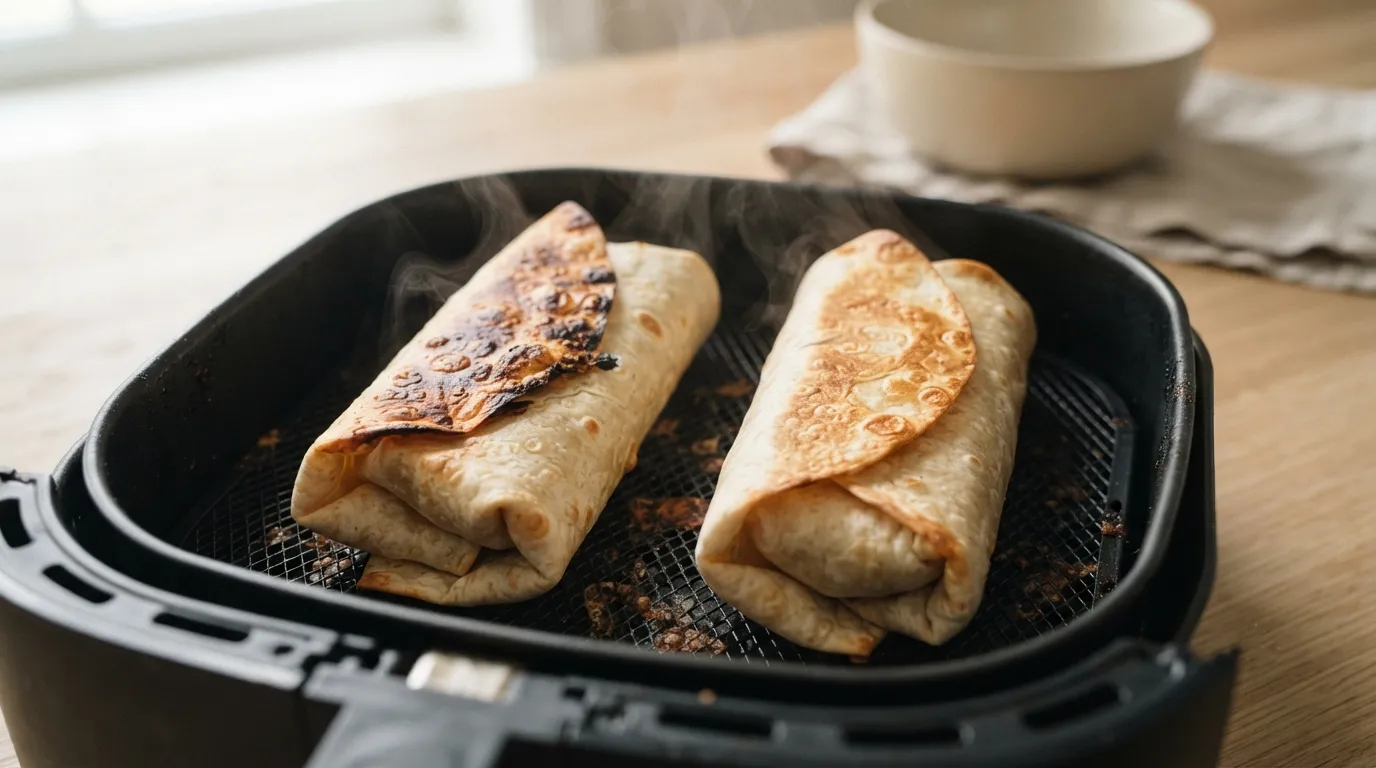
Burritos take about 9 minutes at 380°F (195°C), seam-side down first and turned at 5. Everything inside one is already cooked, so the basket is working on the tortilla and nothing else - which is why a burrito comes out crackling along the seam and the folded ends and softer across the middle, however long you leave it in.
Ingredients
Quantities for 2 burritos (10-inch tortillas) - the times on this page assume that much in the basket.
- 2 flour tortillas (10-inch / burrito size)
- 1 cup refried beans
- 1 cup cooked long-grain rice, leftover is ideal
- 1/2 cup canned corn, drained well
- 1 cup grated cheddar or Monterey Jack
- 2 tsp oil, for brushing the outsides
- 1/4 cup salsa, to serve
- 2 tbsp sour cream, to serve
- A few sprigs of cilantro, to serve
How to air fry burritos
- Warm the refried beans through in a pan or the microwave and stir the rice, the drained corn and half the cheese into them. This is the step that decides whether the middle is hot at nine minutes, and it is far easier than trying to buy the same heat back in the basket. Warm the tortillas briefly so they roll without cracking. Pile half the filling in a line just below the centre of each tortilla, scatter the remaining cheese over it, fold the two short sides in, then roll up tight from the near edge so each burrito finishes seam-side down on the board. Brush the outsides all over with the oil, including the ends. The salsa, sour cream and cilantro are for the table.
- Preheat the air fryer to 380°F (195°C).
- Add the fresh burritos to the basket. Lay them seam-side down in a single layer with a finger's gap between them. Two fit side by side in most 5-6 quart baskets, and a third is worth cooking after rather than wedging in - burritos leaning against one another trap steam along exactly the faces you wanted crisp.
- Cook for about 9 minutes, turning them over at 5 minutes, once the seams underneath have set firm.
Pro tip
A tortilla straight from the pack springs back as you roll it, and the slack that leaves is not only a closure problem. Air trapped between the tortilla and the filling turns to steam the moment the burrito warms up, so the loose stretches of the wrap spend the cook being steamed from the inside while the tight ones toast. Ten seconds in a dry pan, or fifteen in the microwave under a damp cloth, is the whole fix - a warm tortilla goes round and stays where you put it.
How to tell when it's done
Nothing in the burrito on this page is raw, so there is no thermometer figure to hit and done means two things that arrive separately. Outside, the seam and the folded ends should be dark gold and stiff enough that the burrito holds its own shape when you lift it with tongs, while the single-thickness middle stays a lighter, more even gold and still gives a little - that is finished rather than underdone, and the section below is about why. Inside, the only test worth doing is at the centre: push a thin metal skewer into the thickest part, leave it three seconds and touch it to the back of your hand. Warm is not there yet; too hot to hold for more than a moment is. If the middle is lagging while the outside is already dark, the filling went in cold, and that is a problem to fix in the bowl next time rather than by adding minutes here.
Air fryer burritos: the shell only goes crisp where the tortilla is folded over itself
Nine minutes at 380°F (195°C), seam-side down, turned at five. The doneness note above tells you to accept two textures on one burrito and stop there, which is unusual advice and worth the reason. A burrito's shell is a single flour tortilla with wet filling pressed against the back of it, and the tortilla is not the limitation. Cut the same tortilla into wedges and put it in the same basket and it dries out in a matter of minutes - our tortilla chips page sets out what you get from the flour version, blistered and crisp where it puffs and closer to a pita chip than to a corn one, because gluten sets chewy where masa shatters. It still dries, and it dries because the fan has both of its faces. Roll that tortilla around a hot, wet filling and one of those faces is gone, replaced by the opposite of a drying surface. Water leaves the outside face, more arrives from the filling to take its place, and the two roughly cancel.
Except where the tortilla is doubled. Roll a burrito and there are places - the overlap where the loose edge lies back across the roll, the two tucked ends, the seam itself - where the outer layer of tortilla has another layer of tortilla behind it instead of filling. Dry starch, not a water supply. That layer can give up water through its whole thickness, and the whole thickness is what the word crisp means: browning is a surface event and a few microns of it will do, but crisp is a property of the entire layer, which is why a tortilla in a pan goes brown well before it goes brittle. So a burrito leaves the basket in two textures at once, and the boundary between them is not arbitrary - it is a map of how you rolled it. More minutes will not move that line. They will only darken the side that was always going to be dark, and dry the filling behind it.
Our zucchini page has the near version of this and arrives at the opposite conclusion, which is what makes it worth reading next to this one. There the dried shell and the wet middle are the same body, so off the heat the water travels back out into the shell and softens it from behind within minutes, and the fix has to be an added scaffold, because a zucchini slice has almost no starch of its own to build a crust from. A tortilla has plenty of dry matter of its own to build a crust out of, which is why the flat version crisps at all. Its problem is only that the water belongs to something else and is leaning against it, and that is a far better problem, because unlike the inside of a zucchini it is something you arrange with your hands before the burrito goes anywhere near the basket. Roll it tighter and the wrap travels further round, which is more doubled area. Drain the wet things - salsa and tomatoes especially - and use rice that has already been cooked and cooled rather than a pan of it fresh off the boil, and there is less supply behind the single-thickness middle. Put the seam on the basket floor first, where the heat is most direct and where you wanted the crunch anyway. None of that is a technique for crisping a burrito evenly. There is no such technique. It is a choice about where the crisp goes.
Converting from an oven recipe
If your recipe is written for a conventional oven, lower the temperature by about 25°F (15°C) and reduce the time by roughly 20% to land near 380°F for 9 minutes. Need a different starting point? Use the conversion calculator.
Air fryer burritos: FAQ
Can you cook a frozen burrito in an air fryer?
Yes, and it is a different job from the one on this page. A frozen burrito is fully cooked and deeply cold, so the whole difficulty is getting the centre hot before the outside turns to leather - which means lower and much longer than a fresh one, somewhere around 350°F (175°C) for 15 to 20 minutes depending on its size, turned once, then two or three minutes standing before you bite into it. Go by the middle being steaming hot rather than by the clock, because the sizes vary enormously. Do not thaw it first: a thawed burrito goes limp, and a tortilla that has been wet since the day it was wrapped will not crisp at all. Everything on this page about where the crisp lands still applies, but the folds were decided in a factory, so the machine-rolled seam is usually the only part of it that will ever crackle.
How do you stop an air fryer burrito unrolling?
Put the seam against the basket floor and then leave it alone for the first five minutes. Every recipe tells you the first half of that and none of them tells you the second, which is the part that matters, because seam-side down is not a permanent fix - it is a clamp. There is no crimp on a burrito and nothing in a flour tortilla that sets into a bond, so at the moment it goes in, the only thing holding the loose edge down is the weight of the roll on top of it. What changes is that the trapped edge dries and stiffens against the layer beneath it, and by about five minutes it is rigid enough to hold itself shut, which is what makes it safe to turn. Turn at two and it opens, and once a burrito is open it stays open. The rest is in the rolling: fold both short ends in before you roll rather than tucking them afterwards, keep the filling below the centre line so there is tortilla to spare, and warm the tortilla so it goes round tightly instead of springing back.
How long does it take to air fry burritos?
Air fry burritos at 380°F (195°C) for about 9 minutes, turning them over at 5 minutes, once the seams underneath have set firm. That's for 2 burritos (10-inch tortillas) in a single layer; adjust slightly for a fuller basket or a different model.
What temperature do you air fry burritos at?
Set the air fryer to 380°F (195°C). If you're converting an oven recipe, that's roughly 25°F (15°C) below the oven temperature, with the time cut by about 20%.
Do I need to preheat the air fryer for burritos?
A 2-3 minute preheat gives the most accurate timing and the best browning, but it isn't essential - if you skip it, add a minute or two to the cook time.