Are Air Fryers Safe?
Yes. The interesting part is why, because the three things people worry about - radiation, non-stick coatings and acrylamide - have three completely different answers, and one of them is a genuine point in the air fryer's favour.
8 min read Last updated
Short answer
Yes
An air fryer is a small fan oven: an element and a fan. There is no microwave radiation and no vat of hot oil. The non-stick coating is stable at the temperatures the machine actually reaches, and on acrylamide it is better than the deep fryer it replaces. The real risks are grease fires and loose liners.
Three worries, three different answers
"Are air fryers safe" is really three questions wearing a coat, and they get bundled together in a way that makes all three sound equally murky. They are not. One is a misunderstanding, one is a real chemistry question with a reassuring answer, and one is a genuine issue on which the air fryer is the good option. Taking them apart is the whole job.
- Radiation. A confusion with microwaves. There is nothing here.
- The non-stick coating. A real question. Fine at air fryer temperatures; not fine if you damage it.
- Acrylamide. The one worth caring about - and the air fryer beats the deep fryer on it.
Then there are the risks nobody asks about, which are the ones that actually hurt people: fire and hot fat. Those get a section too.
Radiation
There is no microwave radiation in an air fryer, and the question only exists because both machines are small boxes that cook fast. An air fryer is a heating element and a fan. That is genuinely all it is - the same hardware as a fan oven, in a smaller box, with a faster fan.
The pedantic caveat, which is worth giving because it is where the confusion comes from: a hot element does emit infrared radiation, and infrared is radiation in the physics sense. So does your toaster, your grill, and a campfire. It is heat. It is not ionising, it does not penetrate food the way microwaves do, and it stops the instant the element cools. Nothing in an air fryer is doing anything a grill has not been doing for a century. More on the mechanism in how an air fryer actually works.
Non-stick coatings, Teflon and PFAS
This is the one with a real question inside it. Most air fryer baskets are aluminium with a PTFE-based non-stick coating - the family of materials sold as Teflon. PTFE is a fluoropolymer, which does put it under the enormous PFAS umbrella, and that word is doing a lot of frightening work in headlines at the moment.
The part that matters for your kitchen is narrower, and it comes down to temperature. PTFE is chemically inert and stable through normal cooking. It begins to degrade and give off fumes only when it is taken somewhere around 500°F (260°C) and above - which is why the classic warning is about an empty non-stick pan left on a fierce gas hob, where a thin pan with nothing in it to absorb the heat can scream past that in minutes.
Why an air fryer is structurally safer than that pan
An air fryer cannot reach the temperature at which the coating breaks down. It tops out at 400-450°F, and a thermostat holds it there. The empty-pan-on-a-hob scenario is one where nothing limits the temperature. Here, something does. A working machine simply never gets to the number.
Two more things worth knowing, both of which cut against the scare stories:
- PFOA is not in your basket. The chemical behind most of the older litigation and headlines was a processing aid used to manufacture the coating, not the coating itself, and it was phased out of cookware production years ago. New non-stick cookware is made without it.
- A swallowed flake of PTFE is inert. If you chip the coating and eat a fleck, it passes straight through you. That is not the reason to care about damage.
The reason to care about damage is that a coating which is flaking, blistering or worn through to bare metal keeps on degrading, and it has stopped doing its job anyway - food welds to the bare patches, so the basket is worse than useless. That is a replace-it signal. And the way people get there is entirely avoidable: metal tongs and steel wool. Both cut the coating. Use silicone or wooden tongs, and clean it with a soft sponge - the cleaning guide goes through what not to use.
If you would rather sidestep the whole question, you can: baskets and inserts in stainless steel or ceramic coating exist, and a perforated stainless basket does the same job with no fluoropolymer anywhere near it.
Acrylamide - the one actually worth knowing about
This is the real chemistry question, and it is the one nobody asks. Acrylamide is a compound that forms when starchy foods - potatoes above all, plus bread, crisps and cereals - are cooked with dry heat above about 250°F (120°C). It comes out of the same browning chemistry that makes roasted food taste good: a reaction between a naturally present amino acid and the sugars in the food. It is classed as a probable human carcinogen, and it turns up in chips, toast, roast potatoes and coffee.
So it is not an air fryer problem. It is a browning problem, and browning is the entire point of the machine - which means the honest answer is that an air fryer does not give you zero. What it does give you is less. Studies have found air-fried chips form substantially less acrylamide than deep-fried ones. If the air fryer replaced a deep fryer in your kitchen, this ledger moved in your favour, not against it.
And it is a dial you can turn down, with three things that all follow from the mechanism:
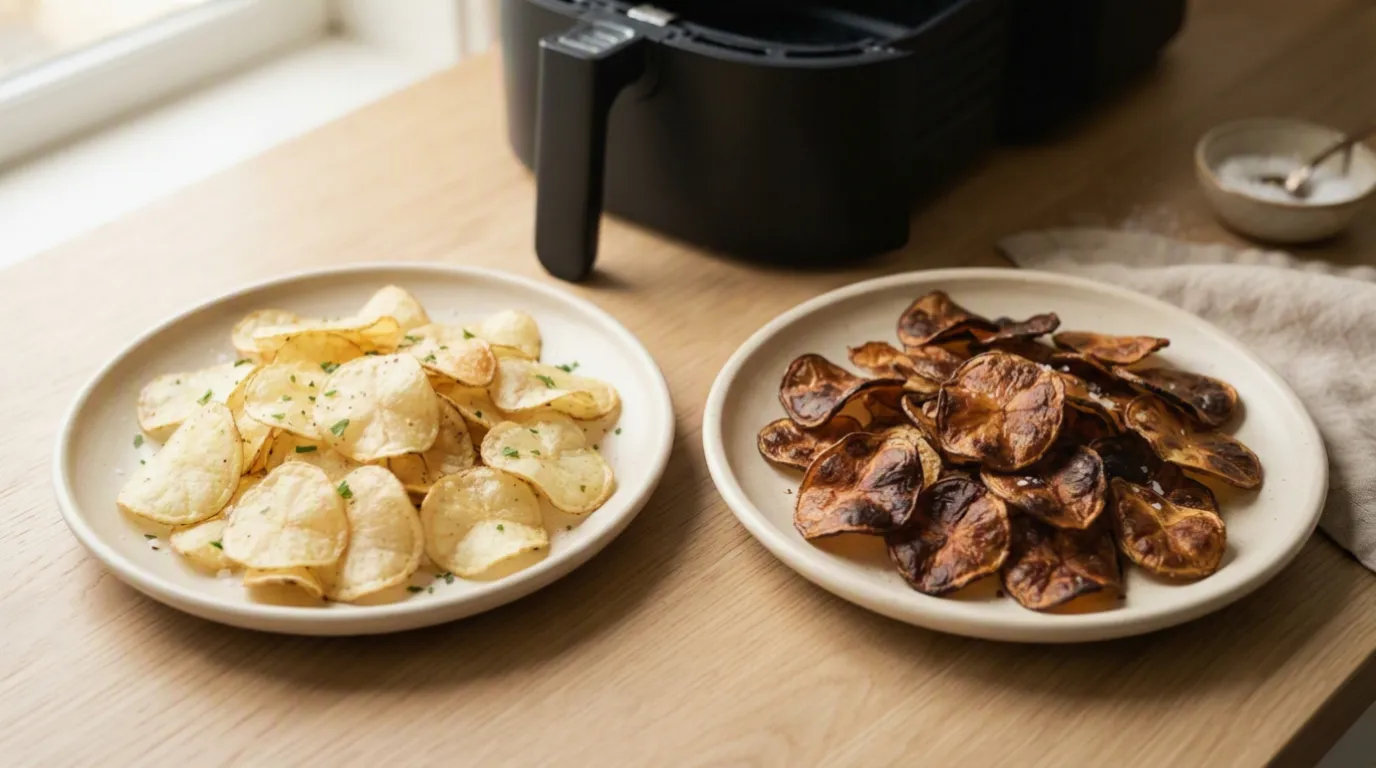
- Cook to golden, not brown. Acrylamide climbs steeply with colour, so the dark, over-crisped chips at the edge of the basket carry far more of it than the pale gold ones. Aim for golden yellow and pull them then.
- Soak cut potatoes, then dry them. Twenty to thirty minutes in cold water rinses out some of the surface sugars that feed the reaction. Dry them thoroughly afterwards - a wet surface will not crisp anyway.
- Do not keep raw potatoes in the fridge. This is the one almost nobody knows, and it is a real effect: cold storage converts potato starch into reducing sugars, and those sugars are exactly the fuel for acrylamide. Refrigerated potatoes brown faster and produce more of it. Keep them somewhere cool, dark and dry instead.
Fire, which is the risk that is actually real
Everything above is chemistry, and the honest summary of the chemistry is "fine". The physical risks are the ones worth spending your attention on, and there are two.
- A loose liner reaching the element. The fan is strong enough to pick up an unweighted sheet of parchment or foil and pin it against a glowing element. This is the most common way people set fire to an air fryer, and it happens most during a preheat, when there is no food holding the liner down. Liners go in under food, never before.
- Grease on the element. Fat splattered onto the element carbonises there and builds up cook after cook. First it smokes; left long enough, it is fuel sitting on an ignition source. Wiping the element once a month removes the whole problem.
Both are boring and both are entirely within your control, which is rather the point. And it is worth keeping the comparison in view: whatever the residual risk here, a machine with no oil in it is a long way safer than a pan of oil at 350°F, which is the thing an air fryer usually replaces.
The sensible precautions, in full
There are not many, and none of them are onerous.
- Four to five inches of clearance behind and above. Not under a wall cupboard, not against a wall, nothing on top.
- Never preheat with a loose liner in. Weigh parchment down with food, or use a silicone one the fan cannot lift.
- Wipe the element monthly. Unplugged, cooled, upside down, damp cloth.
- No metal utensils, no steel wool. This is what kills a coating.
- Do not run it empty at maximum for long stretches - other than the two short burn-off cycles a new machine needs.
- Use a thermometer on meat. The most likely way an air fryer actually makes you ill is undercooked chicken, not the coating - the safe internal temperature is the only real test, and every food page and the cooking times chart carries one.
That last one deserves its place on a safety page more than any of the chemistry does. Food poisoning is a real, common, immediate risk, and it is the one an air fryer genuinely can expose you to - because a machine this fast will brown the outside of a chicken breast convincingly while the middle is still short of 165°F (74°C). Colour is not doneness. Buy the thermometer.
Frequently asked
Are air fryers safe?
Yes. An air fryer is a small fan oven - a heating element and a fan, with no microwave radiation and no vat of hot oil to spill or catch light. The three things people worry about have three different answers: radiation is a non-issue, the non-stick coating is stable at the temperatures an air fryer actually reaches, and on acrylamide an air fryer is measurably better than the deep fryer it replaces. The real risks are mundane ones - grease fires and loose liners.
Is the non-stick coating in an air fryer basket safe?
At air fryer temperatures, yes. Most baskets use a PTFE-based non-stick coating, which is chemically stable in normal cooking and only begins to break down and give off fumes above roughly 500°F (260°C). Air fryers top out around 400-450°F, so a working machine never gets there. PFOA, the processing chemical that drove most of the old headlines, was phased out of cookware manufacturing years ago. The coating stops being fine when it is damaged - see the flaking question.
Should I replace an air fryer basket if the coating is scratched or flaking?
A light scratch is cosmetic. Visible flaking, blistering or bare metal showing through is the point to replace it - not because the flakes are especially toxic (PTFE is inert and passes straight through you) but because a damaged coating keeps degrading, food welds to the bare patches, and you have lost the only thing the coating was for. The way people wreck a basket is metal utensils and steel wool, so avoid both.
Do air fryers cause cancer?
No, and on the one mechanism that is genuinely worth taking seriously - acrylamide - an air fryer is better than the alternative. Acrylamide forms when starchy foods like potatoes and bread are browned at high heat, and it is classed as a probable human carcinogen. It forms in any dry-heat cooking, so an air fryer is not a zero. But studies have found air-fried chips form substantially less of it than deep-fried ones, and cooking to golden rather than dark brown cuts it further.
How do you reduce acrylamide in an air fryer?
Cook to golden yellow, not deep brown - acrylamide rises sharply with colour, so the darkest chips carry most of it. Soak cut potatoes in water for 20-30 minutes and dry them thoroughly before cooking, which washes out some of the sugars that feed the reaction. And do not store raw potatoes in the fridge: cold storage converts starch into the reducing sugars that make acrylamide, so refrigerated potatoes brown faster and produce more of it. Keep them somewhere cool and dark instead.
Can an air fryer catch fire?
It can, and the two realistic routes are both preventable. The first is a loose liner - the fan lifts an unweighted sheet of parchment or foil into the element, where it scorches and can ignite. Liners go in under food, never during a preheat. The second is built-up grease on the element catching light. Keep the element clean, give the machine four to five inches of clearance at the back, and do not run it under a wall cupboard.
Are air fryers safer than deep fryers?
On the whole, yes, and it is not close. A deep fryer is an open vessel of oil held above 350°F - the classic scald and the classic kitchen fire. An air fryer has no oil bath to tip, splash or boil over, its element is enclosed, and it produces less acrylamide in starchy food than deep frying does. It is a swap that removes the biggest hazard in the comparison.