Why Is My Air Fryer Smoking?
Smoke from an air fryer is nearly always fat, and nearly always fixable in about a minute. But one kind of smoke is not fat, and that one means unplug it now. Start by working out which you have.
7 min read Last updated
Short answer
Fat is hitting the element
An air fryer smokes because rendered fat is reaching something hot enough to burn it - either dripping into the drawer below the basket, or already baked onto the heating element from previous cooks. Add a tablespoon of water to the drawer and it stops. If the smoke smells of plastic or electrics rather than cooking, unplug it instead.
First: what kind of smoke is it?
This is the only question that matters, and it takes one sniff. Everything else on this page is about the first two rows of this table. The third row is not a cooking problem.
Thin white wisps, smells of nothing much
Probably not smoke at all - it is steam, coming off wet food, and it is entirely normal. Frozen food and anything you have just washed will do this for the first few minutes. Ignore it.
Blue-grey, smells of burning fat or burnt food
This is the common one, and it is what the rest of this page is about. It is a nuisance, it taints the food, and it is fixable in about a minute. It is not dangerous.
Dark or acrid, smells of plastic, chemicals or electrical burning
Unplug it at the wall now. This is not food. Something is melting or something is failing electrically - a liner that has hit the element, a plastic part that has come loose, or wiring. Do not use the machine again until you have found what it was. The one exception is a brand-new air fryer on its first couple of runs, which is normal and burns off.
1. Rendered fat hitting the element
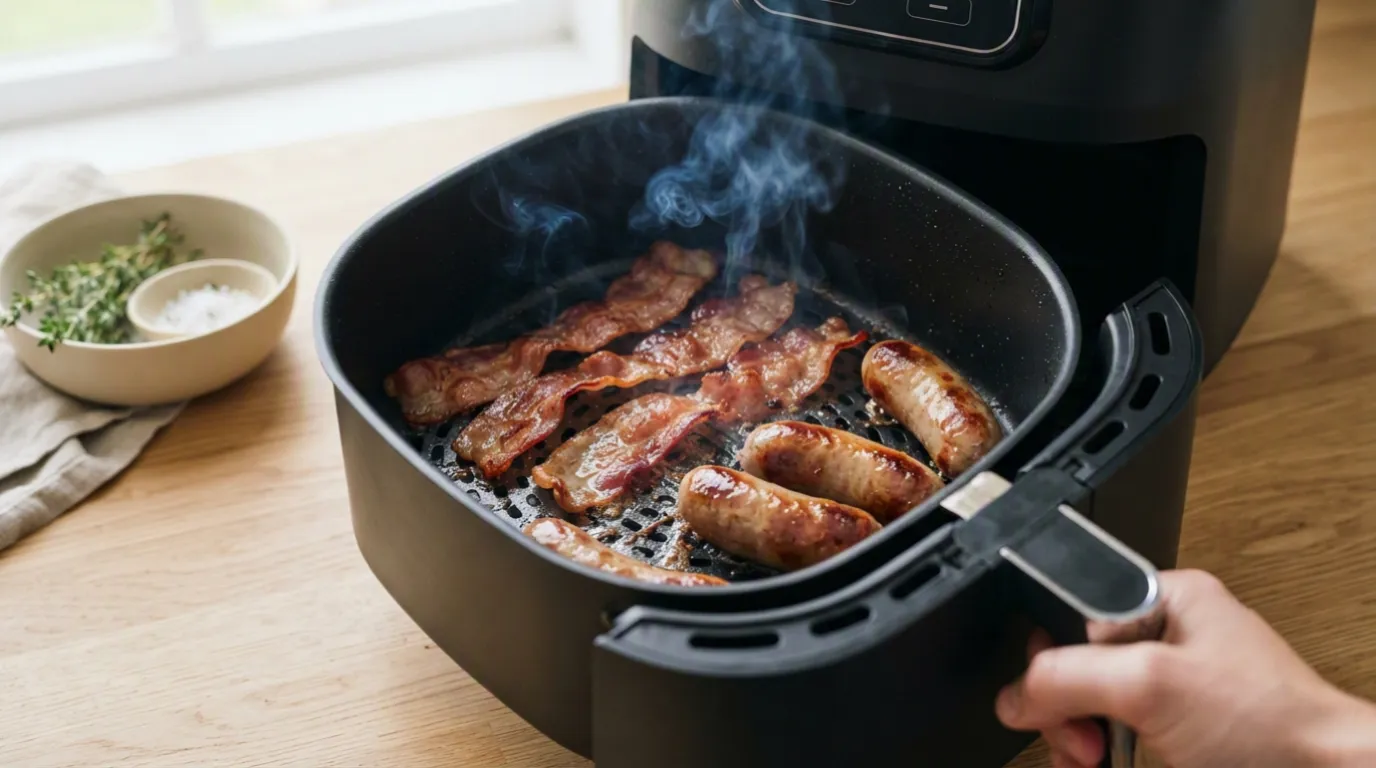
The most common cause by a distance, and the one that has people convinced their new machine is faulty in the first fortnight - because it happens exactly when you cook the things you bought it for. Bacon, sausages, burgers, chicken thighs, pork belly, anything with a decent fat cap.
The mechanism is worth having straight, because it explains why the fix looks so odd. The basket is perforated, so rendered fat falls through it and collects as a shallow pool in the drawer below. That drawer sits in the hottest part of the machine. As the pool heats past the fat's smoke point it begins to burn - and separately, the fan is throwing a fine mist of fat upward onto the element, which is hotter still. Both routes end the same way: fat meeting a surface that is too hot for it.
So you do not need to cook fatty food differently. You need to stop the fat getting hot enough to burn.
2. Old grease baked onto the element
This is the answer when the machine smokes with nothing in it, or smokes while you are cooking something that has no fat in it at all - and it is the one that convinces people the appliance is dying. It is not. It is dirty in a place they have never looked.
Every fatty cook leaves a little carbonised fat on the element above the basket. It builds up, cook by cook, as a hard black speckle. Once it is there, it burns every single time the element comes up to temperature - so a machine that never smoked in its first month starts smoking in its fourth, with food that is doing nothing wrong. Washing the basket will never fix this, because the problem is not on the basket.
The test
Run the machine empty at 400°F for five minutes. If it smokes with an empty basket, the smoke is the machine, not the food. Unplug it, let it cool, turn it upside down and wipe the element - full method in how to clean an air fryer.
3. Your oil is past its smoke point
Every oil has a temperature at which it stops being oil and starts being smoke. The catch is that the oil most people reach for by default - extra virgin olive oil - has one of the lowest smoke points in the cupboard, and it sits below the temperature a normal air fryer recipe asks for. At 400°F you are past it before the food has begun to crisp.
| Oil | Smoke point | In an air fryer |
|---|---|---|
| Avocado oil (refined) | ~520°F (270°C) | Fine at any air fryer temperature |
| Light / refined olive oil | ~465°F (240°C) | Fine at any air fryer temperature |
| Sunflower oil (refined) | ~440°F (225°C) | Fine at any air fryer temperature |
| Groundnut / peanut oil | ~440°F (225°C) | Fine at any air fryer temperature |
| Canola / rapeseed oil | ~400°F (205°C) | Fine up to about 400°F |
| Extra virgin olive oil | ~375°F (190°C) | Will smoke in an air fryer |
| Butter | ~300°F (150°C) | Will smoke in an air fryer |
These are ballpark figures - smoke point shifts with how refined the oil is and how old it is - but the order is reliable, and the order is the useful part. Note that light olive oil is not a lighter version of extra virgin; it is a refined product with a smoke point nearly 100°F higher, and it is genuinely fine in an air fryer. The confusion between the two bottles causes a lot of smoke.
Butter is worth calling out separately: at ~300°F it will smoke in almost any air fryer cook. If a recipe wants butter for flavour, brush it on after.
4. A liner has got into the airflow
A sheet of parchment or foil that is not weighed down by food does not stay on the base. The fan is strong enough to lift it, and there is only one place for it to go: up, against the element, where it scorches, smokes and can catch light. This is the single most common way people set fire to an air fryer, and it happens most during a preheat, when the basket is empty and there is nothing holding the liner down.
Liners go in with the food already on top of them, never before. More on the whole question in can you put parchment paper in an air fryer and can you put aluminum foil in an air fryer.
5. It is brand new
If the machine came out of the box today and it is putting out a faint smoke or haze that smells chemical rather than of food, that is manufacturing residue - protective oils and coatings on the element and the housing - burning off. It is expected, it is not a fault, and it goes away.
Run it empty at around 400°F (200°C) for 10-15 minutes with a window open, and let it cool. One or two cycles is normally enough. If it is still doing it after that, or the smell is strong rather than faint, treat it as the plastic-smell problem instead: air fryer smells like plastic.
The water trick, and why it works
This is the fix for the common case, it takes ten seconds, and it is the thing to try before anything else.
Do this
Pour one to two tablespoons of water into the outer drawer, underneath the basket - not into the basket with the food. Then cook as normal.
The reason it works is neat, and it is not "the water washes the fat away". Water boils at 212°F (100°C) and it cannot get hotter than that while it is still liquid - all the extra energy goes into turning it to steam, not into raising its temperature. So a film of water in the bottom of that drawer pins the pool of rendered fat sitting on it to roughly boiling point, which is hundreds of degrees below the temperature at which fat smokes. The fat is still there. It simply cannot get hot enough to burn.
It does not steam your food and it does not cost you any crisping, because the water is sealed away below a perforated basket in a chamber with a fan hurling air out past it. People are reliably nervous about this and it is genuinely fine - the bacon will still be crisp.
And if that does not fix it, run down the list in order:
- Run it empty. Still smoking? It is the element - clean it.
- Check which oil you used. Extra virgin olive oil or butter? Swap it.
- Check for a liner that has lifted, or one you preheated with.
- Is it brand new? Burn it off and stop worrying.
- Smells of plastic or electrics? Unplug it.
Frequently asked
Why is my air fryer smoking?
Almost always because fat is landing on the heating element. Fatty foods like bacon, sausages, burgers and chicken thighs render a lot of grease, the fan drives it around the chamber, and any that reaches the element burns instantly. Pour a tablespoon of water into the drawer underneath the basket and it stops - the water keeps the pooled fat below its smoke point. The other common cause is old grease already baked onto the element from previous cooks.
Is it dangerous if my air fryer is smoking?
Usually not. Smoke that smells of cooking - burnt fat, burnt food - is a nuisance and it taints flavour, but it is not a hazard, and it stops as soon as you remove the cause. What is not safe is smoke that smells acrid, chemical, of plastic, or of burning electrics, particularly if it is dark. That is not food. Unplug the machine at once and do not use it again until you know what melted.
How do you stop an air fryer from smoking with fatty food?
Add one to two tablespoons of water to the outer drawer, underneath the basket - not into the basket with the food. Rendered fat drips through the perforations and pools in that drawer, directly over the hot base, where it climbs past its smoke point and burns. A little water sits under the fat and holds the pool near boiling point, which is far too cool to smoke. It does not touch the food or affect crisping in the slightest.
Why does my air fryer smoke with nothing in it?
Because the smoke is not coming from tonight's food - it is coming from the machine. Fat aerosolised by the fan lands on the heating element and carbonises there, cook after cook, and it goes on burning every time the element gets hot regardless of what is in the basket. Unplug it, let it cool, turn it upside down and wipe the element with a damp cloth and a soft brush. The exception is a brand-new machine, which smokes on its first run from manufacturing residue and is entirely normal.
Can olive oil make an air fryer smoke?
Extra virgin olive oil, yes - and this catches a lot of people out because it is the oil they keep on the counter. Its smoke point is around 375°F (190°C), which is below the 400°F (200°C) most air fryer recipes call for, so it is smoking before the food has even started to crisp. Light or refined olive oil is a completely different product with a smoke point around 465°F (240°C) and is perfectly fine. So is avocado oil.
Can parchment paper make an air fryer smoke?
Yes, if it gets near the element. An air fryer fan is strong enough to lift an unweighted sheet of parchment off the base and pin it against the element above, where it scorches, smokes and can catch fire. Parchment goes in with food already on top of it, never during a preheat, and never as a full sheet that blocks the perforations. The same applies to foil.