How to Clean an Air Fryer
Most cleaning advice stops at the basket. But the basket is not the part that smokes, and it is not the part that makes last week's fish turn up in tonight's cookies. Here is the whole machine, in the order that actually matters.
8 min read Last updated
Short answer
Basket every use, element once a month
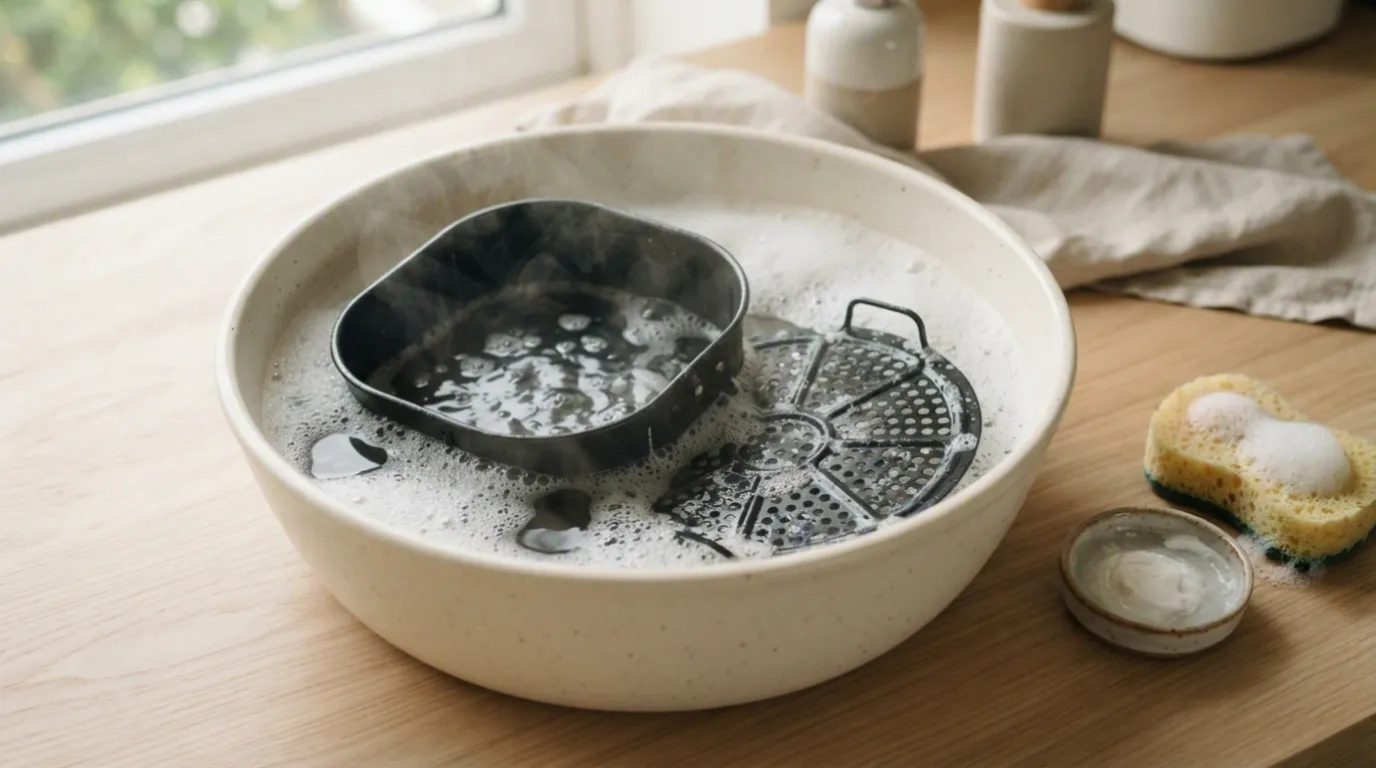
Unplug it and let it cool. Wash the basket, crisper plate and drawer in hot soapy water with a soft sponge - while they are still warm, because warm grease lifts and cold grease has set. Then once a month, turn the machine upside down and wipe the heating element. That last one is the part nobody does, and it is the part that smokes.
The five-minute routine
There is a version of this job that takes five minutes and a version that takes forty, and the only thing separating them is when you do it. Fat that comes out of food is liquid while the machine is warm. Every subsequent heat cycle drives more of the moisture out of it and polymerises it a little further, until what was a wipe becomes a varnish. Clean it warm and you are wiping up oil. Leave it a week and you are chiselling off a coating.
So, after each cook, once it is cool enough to handle:
- Unplug it. You are about to put a wet cloth near an element.
- Lift the crisper plate out of the basket. On most basket models these are two separate pieces, and the gap between them is exactly where grease hides. If you have never separated them, go and look now.
- Hot water, washing-up liquid, soft sponge. Both pieces, plus the drawer.
- Wipe the inside of the machine with a damp cloth - walls and the fan grille.
- Dry everything before it goes back in. Trapped water under a crisper plate will steam your next cook and rust the contact points on a cheaper basket.
Cleaning the basket and the drawer
Nearly every article on this stops at the basket, which is odd, because on a drawer-style air fryer the basket is the part that gets the least dirty. It is perforated. The whole design intent is that fat falls through it. So the fat is not on the basket - it is in the drawer underneath, in a shallow pool that you cannot see unless you take the basket out and look.
That pool is what goes rancid, and rancid fat is what makes a machine smell like old chip shop even though the basket looks spotless. If you clean one thing tonight, clean the drawer.
The one that changes things
Take the crisper plate out of the basket. They come apart - there is usually a small release catch or the plate just lifts. Grease collects in the seam between the two and in the feet the plate stands on, and it will sit there for months if you only ever wash the assembly as one unit. It is the single most common "why does my air fryer still smell" answer.
Baked-on grease: soak, do not scrub
If it has already gone hard and brown, the instinct is to attack it, and that instinct will cost you the basket. Non-stick coating is a thin layer sitting on aluminium. A metal scourer or a scouring pad does not remove the grease from the coating; it removes the coating along with the grease. You will not see much damage the first time. You will see it the third time, when food starts sticking in the exact patches you scrubbed hardest, and from then on that basket is worse than it was before you cleaned it.
Do it the slow way instead, which is faster:
- Soak it. Hot water and washing-up liquid, filled to cover the mess, left for 20-30 minutes. Hot water softens carbonised fat given time - you are letting chemistry do the scrubbing.
- Then baking soda for whatever survives. A thick paste of baking soda and a little water, spread on the stubborn patches, left 15 minutes, worked gently with a soft brush. Baking soda is the right abrasive here precisely because it is a weak one: hard enough to break up carbon, soft enough that it will not score the coating.
- Repeat rather than escalate. A second soak beats a harder scrub every time. Nothing about this is urgent.
The heating element - the bit nobody cleans
Look up into the top of your air fryer. The element is a coil sitting directly above where the food goes, with the fan behind it. Every time you cook something fatty, that fan is driving a fine aerosol of hot fat upwards, and some of it lands on a surface running at several hundred degrees. It does not drip off. It carbonises on contact, in a hard black speckle across the coil.
That build-up is the mechanism behind most of the complaints people blame on the machine. It is why an air fryer that never smoked starts smoking after a few months - the smoke is coming off the element, not the food. It is why tonight's cookies taste faintly of last week's salmon. And no amount of washing the basket touches it, because it is not on the basket.
To do it:
- Unplug the machine and let it cool completely. Not "mostly cool". The element holds heat.
- Turn the whole unit upside down, or lay it on its back, so you can see up into the element without craning. This feels wrong the first time and it is entirely fine.
- Wipe the coil with a damp cloth - damp, wrung out, never dripping. Work along it, not across it.
- Use a soft-bristled brush (an old toothbrush is ideal) on the carbonised specks. Gently. It is a thin coil and it is not built to take force.
- Let it dry fully before it goes back on the counter.
Never
Do not pour water into the machine, do not spray anything into it, and do not put the main body anywhere near a sink. The heating element, the fan motor and the control board all live in that housing. The basket and drawer are the only parts that go in water - the rest gets a damp cloth and nothing more.
Is an air fryer basket dishwasher safe?
Usually yes, and your manual will tell you for certain. But "dishwasher safe" is a claim about whether the part survives, not about whether it survives well. Dishwasher detergent is strongly alkaline - that is how it strips fat without you scrubbing - and repeated cycles of hot alkaline water dull and degrade a non-stick coating considerably faster than hand washing does.
So it is a genuine trade-off rather than a rule: the dishwasher is the convenient clean, and the sink is the better one. Hand washing is what makes the difference between a basket that is still properly non-stick in three years and one that needs oiling to stop eggs welding to it after one.
What never to use
- Steel wool, wire brushes and abrasive scouring pads. They take the coating off with the grease. This is the one that permanently ruins baskets.
- Oven cleaner. It is caustic - designed to dissolve carbon off bare enamelled steel. Non-stick and the aluminium under it are not bare enamelled steel, and there is no way to rinse it out of a machine you cannot submerge.
- Metal utensils in the basket. Not cleaning as such, but it is the same injury - a metal tong scraping the base does what a scourer does, one scratch at a time.
- Aerosol cooking spray, as a routine. Worth knowing because it is a cleaning problem disguised as a cooking one: the lecithin and propellants in cheap spray cans build a sticky, gummy film on non-stick that ordinary washing will not shift, and it gets browner every cook. Toss food in oil in a bowl, or use a refillable pump mister.
- Submerging the main unit. Ever. See above.
How often to clean each part
| Part | How often | Why |
|---|---|---|
| Basket and crisper plate | Every use | Grease left on it bakes harder every cycle and starts to smoke. |
| Outer drawer | Every use | This is where the fat actually collects, and it is the part people skip. |
| Heating element | Monthly, or when it smokes | Splattered fat carbonises directly on the element - the main cause of smoke. |
| Interior walls and fan grille | Monthly | Grease film holds smells and goes rancid. |
| Exterior and control panel | As needed | Cosmetic. A damp cloth, never a spray. |
If the machine has started smoking, stop reading the schedule and go and look at the element - that is the cause far more often than anything you are cooking tonight. And if it smells of plastic rather than food, that is a different problem with a different answer: see air fryer smells like plastic.
Keeping it clean is also the cheapest thing you can do for the food itself. A greasy element and a clogged crisper plate both restrict airflow, and airflow is the entire mechanism - crispiness is downstream of a clean basket more than most people realise.
Frequently asked
How do you clean an air fryer?
Unplug it and let it cool. Wash the basket, crisper plate and outer drawer in hot soapy water with a soft sponge, or put them in the dishwasher if the manual allows it. Wipe the interior with a damp cloth. Then, once a month, turn the whole machine upside down and wipe the heating element - that is the part that causes smoke and smells, and it is the part nearly everyone forgets.
How do you wash an air fryer?
Strictly, only three parts get washed: the basket, the crisper plate and the outer drawer, in hot soapy water while they are still warm - warm grease lifts, set grease has to be soaked. Everything else is wiped, not washed. The main body houses the heating element, the fan motor and the control board, so it never goes near a sink: the interior walls get a damp cloth, and the element itself gets a monthly wipe with the machine unplugged and cold. That is the catch hidden in the word. The parts you can safely submerge are the ones that stay cleanest anyway - fat falls straight through the perforated basket into the drawer - while the part that actually causes the smoke is the one you can never hold under a tap.
What is the best way to clean an air fryer basket?
Hot water, washing-up liquid and a soft sponge, done while the basket is still warm rather than the next morning. Warm grease lifts; cold grease has set. If it has already baked on, soak the basket in hot soapy water for 20-30 minutes and it will come away without scrubbing. Never use steel wool or a metal scourer - it strips the non-stick coating, and food will stick to the bare patches from then on.
How do you get baked-on grease off an air fryer basket?
Soak it first, do not attack it. Fill the basket with hot water and a squirt of washing-up liquid and leave it 20-30 minutes so the water can soften the carbonised fat. For anything that survives that, make a paste of baking soda and water, spread it on the stubborn patches, leave it 15 minutes and rub gently with a soft brush or the soft side of a sponge. Baking soda is a mild enough abrasive to lift the grease without cutting into the coating.
Can you put an air fryer basket in the dishwasher?
Usually yes - most modern baskets and crisper plates are dishwasher safe, and the manual will say so. But dishwasher detergent is harsh and alkaline, and over time it dulls and degrades a non-stick coating faster than hand washing does. If you want the basket to keep its coating for years rather than months, wash it by hand. The dishwasher is a convenience, not the better clean.
How do you clean an air fryer heating element?
Unplug the machine, let it cool completely, then turn the whole unit upside down or on its back so you can see up into the element. Wipe it with a damp (not dripping) cloth, and use a soft-bristled brush on any carbonised specks. Never pour or spray water into the machine, and never scrub the element hard - it is a thin coil and it is not built to take force.
Can you use vinegar or baking soda to clean an air fryer?
Baking soda, yes - a paste of baking soda and water is the single most useful thing for baked-on grease, because it is abrasive enough to lift carbon but soft enough not to score the non-stick. Vinegar is better for smells than for grease: it cuts odours but it is an acid, so keep it off aluminium parts and do not leave it sitting. The popular trick of running the machine with vinegar in the drawer is fine occasionally, but plain hot soapy water does more.
How often should you clean an air fryer?
The basket and drawer after every single use, because grease that is left on bakes harder with each cycle until it is genuinely difficult to shift. The element and the interior about once a month, or immediately if the machine has started smoking. Skipping the basket for one cook is not a disaster; skipping it for a fortnight turns a two-minute job into a soaking job.