How Does an Air Fryer Work?
An air fryer is not frying anything. Once you understand what it really is - a small, fierce convection oven - how it works and why the conversion maths lands where it does stops being a mystery.
8 min read Last updated
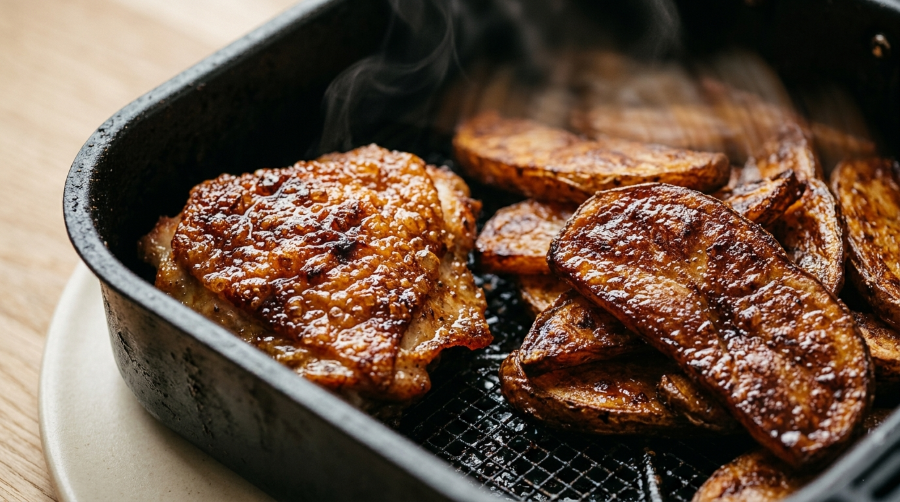
"Air fryer" is one of the great marketing names. Nothing is being fried - there is no oil bath, no submersion, none of the things that make frying frying. So how does an air fryer actually work? What you own is a small, very intense convection oven with a clever basket - it cooks with fast-moving hot air, not oil. Once that clicks, the whole thing gets predictable: you can look at an oven recipe and know, roughly, what it will do in the basket. This guide explains the mechanism step by step, and why our conversion calculator lands where it does.
What it really is
Strip the lid off the idea and an air fryer is three parts: a heating element, a fan, and a perforated basket sitting in a small chamber. The element gets hot, the fan drives that heat down and around the food, and the perforations let the air reach the underside too. That is the whole mechanism - no oil involved, just hot air moving fast over a dry surface. Once you picture those three parts working together, most of how an air fryer cooks food falls into place.
Is an air fryer just a convection oven?
Pretty much - and the comparison is the fastest way to understand one. A convection oven is simply an oven with a fan; an air fryer is that same idea shrunk to the size of a shoebox, with a more powerful fan sitting inches from your food rather than behind a baffle at the back of a large cavity. Same physics, different scale. So when people ask whether an air fryer is a convection oven, the honest answer is: it is a small, fierce one.
The differences between an air fryer and a convection oven are all knock-on effects of that size:
- Speed. The tiny chamber preheats in 2-3 minutes and the close, fast fan cooks the surface quicker, so most foods finish in less time than a full-size convection oven.
- Crisping. Faster airflow over a smaller load means drier, crisper results - the air fryer's real party trick.
- Capacity. The trade-off: a convection oven swallows a tray of food or a big roast, while a basket cooks a portion or two at a time.
- Energy. For small batches the air fryer usually wins, because there is far less metal and air to heat; for a full meal a single oven run can be more efficient.
There is a fifth difference that matters more than any of them, and it is not a setting: the food sits in a perforated basket rather than on a solid pan, so moving air reaches its underside. Our full air fryer vs convection oven comparison works through all of it - including whether the "Air Fry" button on a modern oven is the real thing.
Convection and the Maillard reaction
Two bits of food science do all the work here. The first is convection: heat carried by moving air. Still air is a poor conductor - it is why a 200°F (93°C) oven feels survivable for a second but 200°F water would scald you. Move that air fast, though, and it strips heat onto the food far more efficiently, the same way a fan-forced wind chill cools you quicker than still cold air. That is what the air fryer's fast, close fan is doing: pushing more air, faster, against more of the surface.
The second is the Maillard reaction - the cascade of reactions between amino acids and sugars that browns food and builds savory, roasted, toasted flavor. It needs a dry, hot surface, and it really gets going above about 285°F (140°C). Because the air fryer dries and heats the surface so quickly, it triggers browning fast and evenly. That is why fries, chicken skin and roast veg come out of a basket looking lacquered while the same time in a slow, humid oven leaves them pale.
Why it cooks faster
Three things stack up. Preheat is almost instant - there is barely any metal or air to bring up to temperature, so the machine is ready in 2-3 minutes versus 10-15 for an oven. Heat transfer is higher because of that fast, close airflow, so the surface cooks more quickly at any given temperature. And the small chamber recovers its heat almost immediately after you open it, where a big oven sheds warmth every time the door swings. Add it up and most foods are done in roughly 80% of the oven time - the basis of the "cut the time about 20%" half of the rule.
The conversion rule, and why it is what it is
The standard rule is lower the temperature ~25°F (15°C) and cut the time ~20%. Now you can see where each half comes from. You drop the temperature because the efficient airflow would otherwise brown - then scorch - the surface before the inside catches up; a lower set point keeps the outside in step with the center. You cut the time because preheat, heat transfer and heat recovery all run in your favor.
One unit-conversion trap worth flagging: 25°F is a difference of about 15°C, not 25°C. Plenty of charts wrongly tell Celsius users to drop 25°C, which over-corrects badly - take 200°C down to 175°C, not to 150°C. Our calculator handles this correctly, which is half the reason it exists.
When the rule breaks
A single flat rule cannot be right for everything, because foods do not all care about surface heat the same way. The rule is most reliable for the things air fryers are made for - anything you want crisp and browned, cooked in a single layer. It gets shakier at the edges:
- Cakes and delicate bakes want gentle, even heat. The fierce airflow can set and brown the top before the middle rises, so drop the temperature a little further and watch closely - or just use the oven.
- Big, dense roasts are limited by how fast heat conducts to the center, not by surface heat, so the time saving shrinks - and the basket is too small for most of them anyway.
- Already-fanned (convection) oven recipes have part of the discount baked in, so you lower the temperature less than you would from a conventional oven.
This is exactly why a flat "minus 25, minus 20%" chart only gets you close. Our calculator adjusts for your oven type and the food, and the cooking times chart gives recommended settings when you would rather not convert at all. Either way, the principle underneath is the same: it is a small convection oven, and the air is doing the work.
Frequently asked
How does an air fryer work without oil?
It does not need an oil bath because it is not frying - it browns food with fast-moving hot air. A thin coat of oil helps crisping and flavor, but the cooking and browning come from convection heat hitting a dry surface, not from oil.
Do air fryers use radiation to cook?
No - not in the microwave sense. An air fryer cooks almost entirely by convection (hot moving air), plus a little radiant heat from the element, exactly like a fan oven. There is no microwave radiation involved, which is why it browns and crisps food rather than steaming it.
Do air fryers actually fry food?
No. There is no oil bath and nothing is submerged, so technically it is roasting or baking with very fast hot air. It mimics the crisp, browned result of frying without the oil - hence the misleading name.
Why do you lower the temperature when converting an oven recipe?
Because the air fryer's fast-moving air transfers heat to the surface of the food much more efficiently than the still or gently circulated air of an oven. To get the same result without burning the outside, you drop the set temperature by about 25°F (15°C).
Does the air fryer cook food from the inside?
No. Like any oven, it heats the surface, and that heat then conducts inwards. Nothing cooks food from the center out at home - which is exactly why a thermometer in the middle is the only reliable test of doneness.