Air Fryer Temperatures Explained
Why does one recipe say 360°F and another 200°C for the same fries? Here is the full °F-to-°C chart, what each band of the dial does, common food temperatures, and how to pick a setting with confidence.
7 min read Last updated
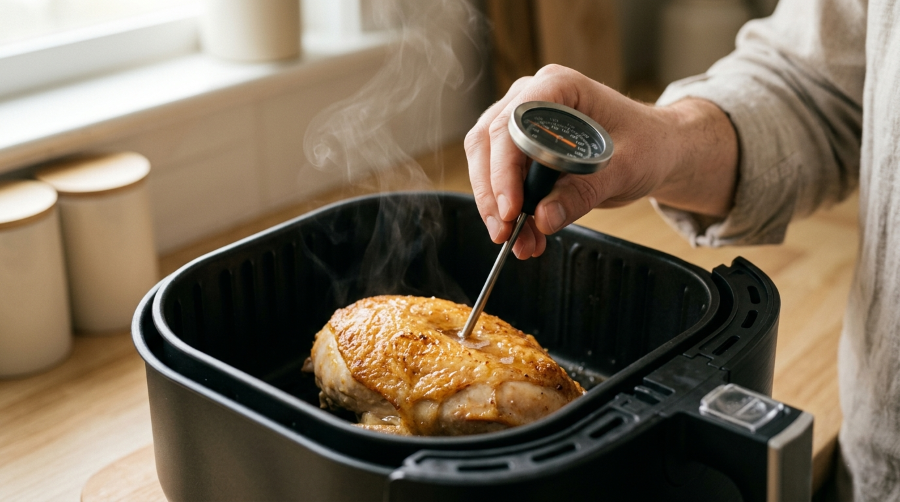
Half the confusion with air fryers is temperature. One recipe says 360°F, the next says 200°C, your dial only goes in fives, and nobody explains why any particular number. Here is the whole thing in plain English: how to convert between the units without getting it wrong, what each part of the dial is actually for, and how to choose a temperature for anything.
°F to °C, properly
There are two different conversions and people mix them up constantly. To convert an actual temperature you use the formula (°F − 32) × 5/9 = °C. But to convert a change in temperature - "lower it by 25°F" - you only scale the gap: 25°F of difference is about 15°C, not 25°C. That second one is the trap in oven-to-air-fryer charts. Here are the settings you will actually use:
| Fahrenheit | Celsius | Typical use |
|---|---|---|
| 300°F | 150°C | Gentle reheating, custards, dehydrating |
| 325°F | 160°C | Bakes, thick bone-in chicken, nuts |
| 350°F | 180°C | The everyday middle: fish, chicken, veg |
| 375°F | 190°C | Roasting, sausages, breaded foods |
| 400°F | 200°C | Fries, wings, most frozen foods |
| 425°F | 220°C | Maximum crisp, quick blast finishes |
Do not agonise over the exact number. Air fryers are not laboratory-precise, and 350°F vs 360°F changes nothing you can taste. Each of those rows also has a dedicated page with the foods that cook at it - for example 180°C, 200°C, 220°C and 400°F.
Switching your air fryer between °C and °F
If your air fryer is showing the wrong unit, you usually do not have to live with it. The method varies by brand and the manual rarely makes it obvious, but on most digital models the trick is to hold the temperature button - sometimes the temp and time buttons together - for about three seconds until the display flips between °C and °F. It is worth a quick check of your manual for the exact combo, since brands like Cosori, Dreo and Nuwave each place it slightly differently.
Two caveats. Some dial-based machines - several Ninja models among them - only ever display one unit and cannot be switched at all; US units tend to be locked to Fahrenheit, UK ones to Celsius. And if the unit changes but you are mid-cook, the number on screen will jump (180 becomes 356) without the actual heat changing. Either way, the chart above lets you convert in your head, so a fixed unit is never really a problem.
What each band of the dial is for
Think of the dial in three zones rather than as fifty individual numbers:
- Low, 250-325°F (120-160°C): gentle and forgiving. For reheating without drying out, cooking thick or delicate things through, baking, toasting nuts, and dehydrating. Little browning - that is the point.
- Medium, 350-375°F (180-190°C): the workhorse. Enough heat to brown and crisp, gentle enough that most foods cook through before the outside overdoes it. If you are unsure, start here.
- High, 400-450°F (200-230°C): fast and fierce. For thin foods you want crisp quickly - fries, wings, breaded items - and for a short finishing blast to crisp the outside of something already cooked through.
Choosing a temperature for any food
Two questions get you there nearly every time. First, how thick is it? Thin foods can take high heat because the center is never far from the surface; thick foods need a more moderate setting so the middle reaches temperature before the outside burns. Second, do you want it crisp or gentle? Crisp wants higher heat and a dry, lightly oiled surface; gentle (eggs, cake, reheating) wants lower heat. Anything that needs both - crisp outside, cooked-through thick inside - is the classic case for moderate heat first, then a high blast at the end.
High heat vs low heat, in practice
A worked example: a thick bone-in chicken thigh at 400°F (200°C) the whole way will give you gorgeous skin over slightly underdone meat near the bone. Cook it at 360°F (180°C) until the center hits a safe 175°F (80°C), then ramp to 400°F for the last 3-4 minutes, and you get both - cooked through and crisp. That two-stage idea, moderate-then-high, solves most "crispy outside but raw inside" problems. For the exact starting numbers on a specific food, the cooking times chart has recommended settings, and the conversion calculator will translate any oven recipe for you.
Common food temperatures at a glance
The most-asked question is simply "what temperature do I air fry this at?" Here are reliable starting points for the foods people look up most. Times are a guide for a typical single-layer batch - tap any food for the full method, doneness checks and how it scales.
| Food | Temperature | Approx. time |
|---|---|---|
| Chicken breast | 375°F / 190°C | 15 min |
| Chicken wings | 400°F / 200°C | 20 min |
| Chicken thighs (bone-in) | 375°F / 190°C | 25 min |
| Chicken tenders | 375°F / 190°C | 12 min |
| Salmon fillet | 380°F / 195°C | 10 min |
| Steak | 400°F / 200°C | 12 min |
| Pork chops | 380°F / 195°C | 12 min |
| Beef burgers | 375°F / 190°C | 12 min |
| Bacon | 350°F / 175°C | 10 min |
| French fries (frozen) | 400°F / 200°C | 18 min |
| Brussels sprouts | 375°F / 190°C | 12 min |
| Broccoli | 375°F / 190°C | 8 min |
That is a snapshot - the full air fryer cooking times chart covers every food with recommended temperatures and times in both units.
Frequently asked
What is 180°C in an air fryer in Fahrenheit?
180°C is about 350°F (356°F exactly, but air fryer dials round to 350°F or 360°F - either is fine). It is the everyday middle setting for chicken pieces, fish and roast vegetables.
What temperature should I set my air fryer to?
For most savory food, start around 375-400°F (190-200°C). Drop to 320-350°F (160-175°C) for delicate items, bakes, or thick pieces that need to cook through gently; go to 400°F+ (200°C+) for thin foods you want crisp fast, like fries and wings.
What is 200°C in an air fryer in Fahrenheit?
200°C is about 400°F. It is the high, crisp end of the dial - the setting for fries, wings, roast potatoes and most frozen foods. 220°C is roughly 425°F for a maximum-crisp blast.
How do I change my air fryer from Celsius to Fahrenheit?
It varies by brand, but on most models you hold the temperature button (sometimes the temp and time buttons together) for about three seconds until the display flips between °C and °F. Check your manual for the exact combo. Some dial-based models - several Ninja air fryers, for example - only ever show one unit and cannot switch; in that case use the conversion chart above.
Is a higher temperature always crispier?
Up to a point. High heat crisps the surface fast, but if the food is thick it can scorch outside before the center is done. For crunch on thick items, the trick is often a moderate temperature to cook through, then a short blast at high heat to finish.