Air Fryer Acorn Squash
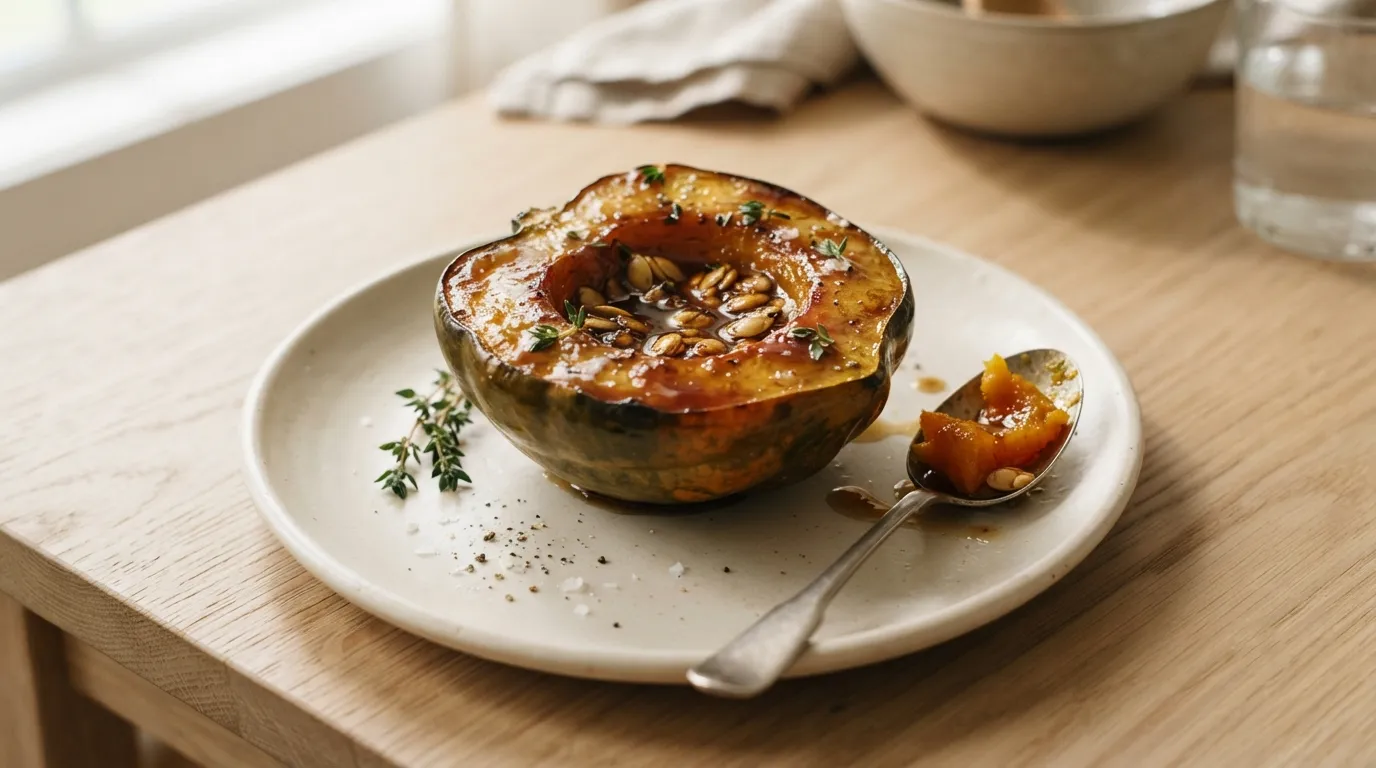
Temperature
375°F
190°C
Time
25 min
1 squash (2 halves)
Heat through to
Piping hot
cooked right through
Prep
10 min
Cook
25 min
Total
35 min
An acorn squash half is the most sealed thing in this basket. The rind is a storage organ - it is what lets a winter squash sit in a cupboard for a month or two - and it does not let water through, so halving the squash is not only about making it fit. It opens the one face that heat, steam and browning are all going to have to share. That is why twenty-five minutes at 375°F (190°C) is the longest any vegetable on this site takes apart from the potatoes, and also why it comes out silky rather than shrivelled when almost everything else in a basket dries at the edges.
Ingredients
Quantities for 1 squash (2 halves) - the times on this page assume that much in the basket.
- 1 acorn squash (about 1.5 lb / 700g), halved and seeded
- 1 tbsp olive oil, for the cut faces
- 1/2 tsp flaky salt
- Black pepper
- 2 tbsp butter, 1 tbsp into each half
- 2 tbsp maple syrup, 1 tbsp into each half
- 2 tbsp toasted pumpkin seeds (pepitas), to serve
- A few sprigs of fresh thyme, to serve
How to air fry acorn squash
- Cut the squash from stem to tip, running the knife down a ridge rather than across the ridges - it splits far more willingly along one, and a heavy blade rocked from the tip is steadier than one pushed straight down on a rolling shell. Scoop out the seeds and the stringy fibres with a spoon and scrape the cavity properly clean, then brush the cut faces with the oil and season them. They go into the basket cut side down. The butter and maple syrup go into the cavities at the turn rather than at the start - ten minutes is enough for a glaze, where twenty-five would simply boil it away - and the pepitas and thyme are scattered over as the halves come out, since both are small and dry enough to scorch long before the squash is ready.
- Preheat the air fryer to 375°F (190°C).
- Add the fresh acorn squash to the basket. Two halves sit side by side in most 5-6 quart baskets. If only one lies flat in yours, cook them one after the other rather than stacking them or wedging the second one in at an angle - a half propped on its neighbour has its cut face out of the airflow.
- Cook for about 25 minutes, turning them cut side up after about 15 minutes.
Pro tip
Buy the dull one. A shiny rind means the squash was picked before it matured and it will not have developed its full sweetness - the gloss on a young fruit goes matte as it ripens on the vine. Then weigh it in your hand: one that feels light for its size has been in storage long enough to dry out, and it will cook up fibrous however long you give it.
How to tell when it's done
Fork-tender is the right test, and where you push the fork decides whether it is true. A half is not an even thickness: the stem and tip ends are solid flesh, while the middle is only a wall around the seed cavity, so the thin part gives way several minutes before the ends do - test the solid flesh beside the stem. Alongside that you want deep brown along the cut edge and a cut face that looks glossy and a little sticky rather than wet. If the stem end still resists at twenty-five minutes, give it three or four more at the same setting rather than turning the heat up: the flesh is dense and the heat has one way in, so more heat browns the face you can already see instead of reaching the part that is still hard.
Acorn squash in the air fryer: five sides are sealed, so everything happens through the sixth
One squash, halved, 375°F (190°C), twenty-five minutes, cut side down for the first fifteen. Two things about that are odd if you have cooked anything else in a basket. It is the longest cook of any vegetable on this site bar the potatoes - ten minutes more than a whole head of cauliflower, for something with less food in it - and it still comes out moist and silky rather than with the dried, slightly leathery edges fast dry air gives almost everything else. Both come from the same place, and it is not the machine. It is the shell.
A winter squash rind is a storage organ. It is the reason you can buy one in October and cook it in December, and what it is good at specifically is not letting water through - the fruit is a sealed package with several months of food in it. Cut one in half and you have not made two smaller vegetables; you have made a sealed vessel with a hole in it. Water can only leave through the cut face. Browning can only happen on the cut face. Heat can travel in through the rind, but nothing else moves either way. This site has met that idea twice before from the other side: on corn on the cob, a few hundred kernel skins hold and the machine gets undeserved credit for the juiciness, and on green beans the pod's seal fails and the blister where it goes is the thing you are cooking for. An acorn squash is the third case - one seal, and we cut it open deliberately - so every decision in the recipe is really about that single opening.
Which turns two questions that get answered by preference into questions with answers. Cut side down first, because the open face is the only part that can take advantage of the basket's hot metal, and our texas toast page already makes the point that metal conducts far better than air does - it is worth spending that on the one surface able to use it. Then turn it, because the glaze wants the last ten minutes rather than the first fifteen. And test the solid flesh beside the stem rather than the thin wall around the cavity, because heat is crossing that flesh from one direction only and the thin part of the half finishes early enough to tell you nothing about the rest. The same fact also explains the forgiving part: five-sixths of this squash cannot dry out, however long you leave it in, which is why an extra four minutes for a stubborn stem end costs you nothing.
Converting from an oven recipe
If your recipe is written for a conventional oven, lower the temperature by about 25°F (15°C) and reduce the time by roughly 20% to land near 375°F for 25 minutes. Need a different starting point? Use the conversion calculator.
Air fryer acorn squash: FAQ
Can you eat the skin on acorn squash?
Yes, and acorn is the winter squash where that is genuinely true rather than technically true. Every winter squash rind is edible, but most of them stay tough enough that you would not want to - the thicker and harder the shell, the longer the fruit stores and the chewier it stays after cooking. Acorn sits at the thin end of that range, which is the trade-off for it keeping a month or two rather than half a year, and twenty-five minutes at 375°F (190°C) leaves it soft enough to cut with the side of a fork and eat along with the flesh. It is also why this recipe never asks you to peel it: peeling a ridged squash is a fight you would be having for no reason, and the rind is what holds the half in shape while it cooks. If yours is an older, harder squash and the skin is still leathery when the flesh is tender, that is the squash rather than the method - scoop the flesh out of the shell and serve it that way.
Can you air fry acorn squash in slices instead of halves?
You can, and it stops being the same job. Cut into half-moons about three quarters of an inch thick, the constraint the halves recipe is built around disappears: every slice has two open faces instead of one, heat comes at it from both sides, and there is no solid stem end left for the thin cavity wall to run ahead of. So it cooks far faster - closer to twelve to fifteen minutes at the same 375°F (190°C), tossed once, rather than twenty-five - and it browns much more, because you have made a lot of new cut surface and put all of it in moving air. What you give up is the part the halves are prized for. A slice can dry, where a half genuinely cannot, and there is no cavity to hold butter, so a glaze has to be tossed through afterwards rather than melted in place. Slices are the better answer if you want caramelised edges to put on a salad or a grain bowl; halves are the better answer if you want a soft, spoonable squash.
How long does it take to air fry acorn squash?
Air fry acorn squash at 375°F (190°C) for about 25 minutes, turning them cut side up after about 15 minutes. That's for 1 squash (2 halves) in a single layer; adjust slightly for a fuller basket or a different model.
What temperature do you air fry acorn squash at?
Set the air fryer to 375°F (190°C). If you're converting an oven recipe, that's roughly 25°F (15°C) below the oven temperature, with the time cut by about 20%.
Do I need to preheat the air fryer for acorn squash?
A 2-3 minute preheat gives the most accurate timing and the best browning, but it isn't essential - if you skip it, add a minute or two to the cook time.