Air Fryer Corn Ribs
Temperature
400°F
200°C
Time
12 min
2 ears (16 ribs)
Heat through to
Piping hot
cooked right through
Prep
10 min
Cook
12 min
Total
22 min
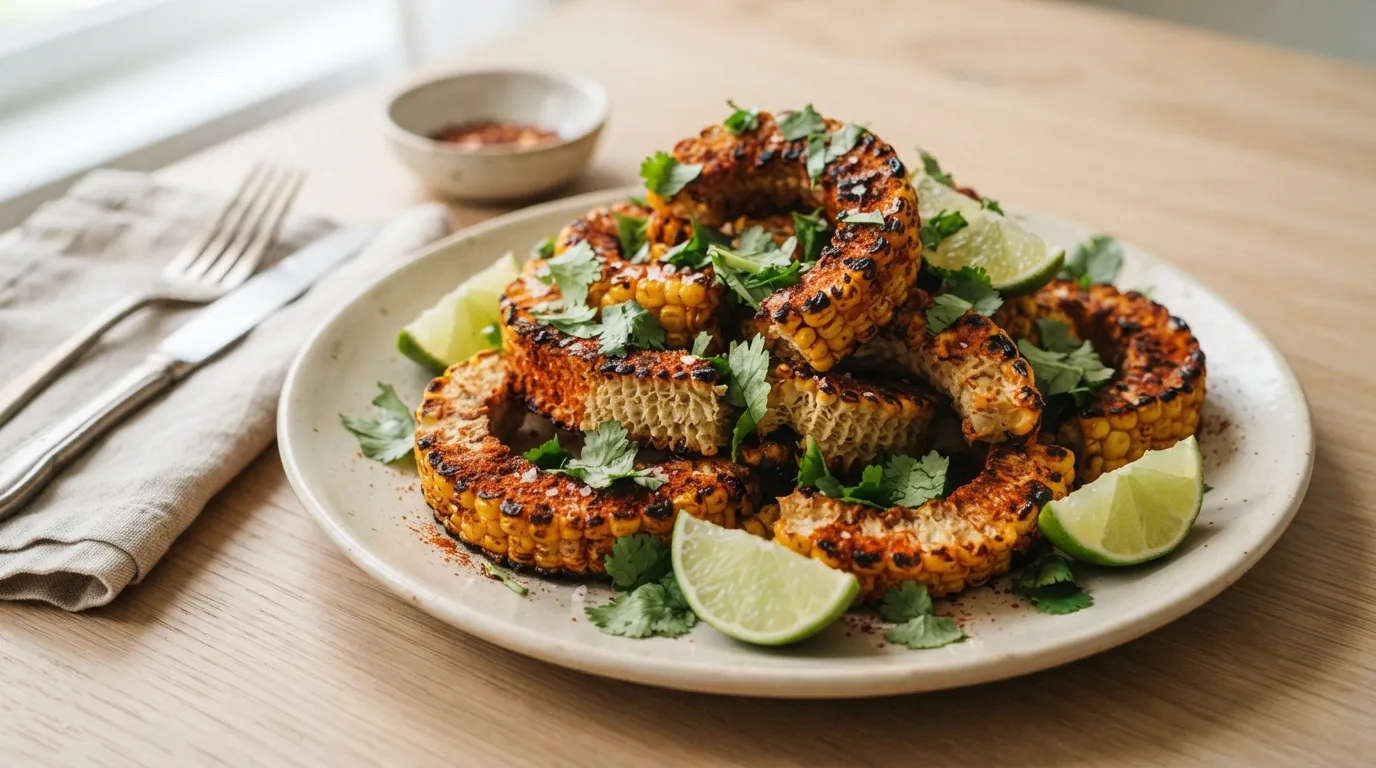
Corn ribs are a cob quartered lengthwise, and the whole appeal is what happens to them in the basket: each piece bends back on itself into something that really does look like a rib, which is where the name came from and why you eat them with your hands. Twelve minutes at 400°F (200°C) does it, and nothing needs turning - a rib has one side worth browning and it goes in facing up. The cutting is the only real work on this recipe, and it goes far better in one particular order.
Ingredients
Quantities for 2 ears (16 ribs) - the times on this page assume that much in the basket.
- 2 ears of corn, husked and trimmed
- 1 tbsp olive oil
- 1 tsp smoked paprika
- 1/2 tsp fine salt
- 1 lime, cut into wedges, to serve
- A small handful of cilantro leaves, to serve
- Flaky salt, to finish
How to air fry corn ribs
- Pull off the husks and the silks and trim both ends flat. Cut each cob in half across the middle first: a four-inch piece stands on its own cut end and stays there, where a whole cob rolls. Then stand a half up, with a damp cloth under the board so nothing slides, rest a heavy knife across the top of it and press the blade down through with the heel of your hand on the spine - a steady push rather than a chop, and with your other hand nowhere near the line the blade is travelling. That gives two half-round pieces; stand each of those up and split it the same way, for four ribs from every piece of cob and eight from every ear. Toss them in a bowl with the oil, paprika and salt until every face has something on it. The lime, the cilantro and the flaky salt go on when they come out.
- Preheat the air fryer to 400°F (200°C).
- Add the fresh corn ribs to the basket. Lay them kernel side up in a single layer and do not let two cut faces touch. Those two pale faces where the knife went through are the only route the cob has out. Sixteen is a squeeze in most 5-6 quart baskets: if they will not all lie flat with a little air around them, run two batches rather than shingling them.
- Cook for about 12 minutes.
Pro tip
Buy for the cob, not for the kernels. The stalk end is the tell - a cut that still looks pale and damp means the ear came out of the field recently, and a browned, shrunken, chalky one means it has been sitting. Everyone says to use fresh corn for this and puts it down to the kernels; it is the cob that decides, for the reason set out below, because an ear that dried out in a fridge drawer has already spent the water the curl runs on. It will taste perfectly good and it will not bend nearly as far.
How to tell when it's done
Go by the shape rather than by the clock. A finished rib has bowed into an arc with the kernels on the outside and both ends lifted clear of the basket floor, so it is sitting on its middle - and it arrives fairly suddenly in the last few minutes rather than creeping up across the twelve. The kernels want to be glossy and swollen, with dark toasted patches on the ones standing proudest of the curve, and the row along each cut edge will always be browner and drier than the rest, because those are the kernels the knife went through. A rib still lying dead straight at twelve minutes has either not had long enough or has had a neighbour resting against it; give it another two or three minutes with a gap around it and look again.
Air fryer corn ribs: the curl is two materials disagreeing, and only one of them can dry
Every page on this dish shows you the curl and none of them says where it comes from. The nearest thing to an explanation on offer is that the pieces are thinner than a whole cob, so they bend - and the thinness is real, but on its own it cannot be the reason. A thin strip of anything uniform dries out and stiffens; nothing about being thin tells it which way to go. Corn ribs go the same way every single time, kernels on the outside of the curve and the pale cob on the inside, and a shape that repeats like that is not a strip giving way under heat. It is one side of the strip changing length while the other side does not.
Our corn on the cob page settles the half of this that is already ours: every kernel is sealed inside its own skin, so it keeps its water however dry the air around it gets, which is the reason corn survives an appliance built to take moisture off things at all. Quartering the cob changes nothing about that. What it changes is the cob, which until the knife went through it was wrapped in kernels and is now two bare flat faces with a great deal of water behind them. So the rib goes into the basket as a long strip with a side that can dry and a side that cannot. The side that can gets shorter as it goes; the side that cannot stays the length it started. A strip joined along its length with that going on inside it has one option and it takes it - it bends, with the shrinking side on the inside - and the kernels finish on the outside of the curve because they were never the side that was going to move. Thinness decides how far it travels rather than whether it happens: the narrower the rib, the more curve you get out of the same mismatch, which is why slim ones curl almost into rings and fat ones only bow. It is also why this wants the top of the dial rather than a gentle roast. The curl is a drying job, and the same ribs given a long gentle roast bend far less and never really char.
Which puts the two cut faces at the centre of a recipe that appears to be entirely about the kernels. They are the only route the water has out, they are the faces nobody is watching, and they are the easy ones to lose: a rib resting against its neighbour, or shingled on top of one to get sixteen into a basket that holds twelve, has had one of its two exits sealed off by a piece of corn. What that costs is not colour and not a burnt edge. It is the curl, and a straight corn rib is only a hard piece of corn. Two other pages here run on the same physics and finish somewhere else, which is the useful way to hold this one. Our tortilla chips page has a curl in it too, and there it is a nuisance: a chip is one material drying all the way through, and curling lifts its edges off the floor of the basket and hands it to the fan. Nothing here is light enough to go anywhere. And our chicken sausage page has this exact mismatch with the opposite ending - a casing contracting around a filling that is expanding - because there the two materials are wrapped one inside the other, so the disagreement has nowhere to go but a split. Lay the same two materials side by side instead and it has somewhere to go: it turns into a shape, and here the shape is the dish.
Converting from an oven recipe
If your recipe is written for a conventional oven, lower the temperature by about 25°F (15°C) and reduce the time by roughly 20% to land near 400°F for 12 minutes. Need a different starting point? Use the conversion calculator.
Air fryer corn ribs: FAQ
How do you make Mexican street corn ribs in an air fryer?
Cook them exactly as this page does, then dress them off the heat. The elote treatment - mayonnaise or crema, crumbled cotija, chili powder, lime - is a list of things that split, scorch or turn bitter well before twelve minutes at 400°F (200°C) is up, which is the same call our carrots page makes about honey and our meatloaf page about ketchup: anything that browns on its own goes on at the end. There is a second reason here that belongs to the shape. The channels between the kernels are not open when the ribs go in; they open as the rib curls. So a dressing brushed on beforehand sits on the kernel tops, and the same dressing brushed on afterwards gets down between them. Do it in that order - crema while they are still hot, cotija scattered on so it softens rather than melts, then the chili and a hard squeeze of lime.
Is it easier to cut corn into ribs if you microwave it first?
Yes, and if the knife is the part of this you are not looking forward to, it is the right move. Two minutes on high with the cob husked, then long enough on the board that you can hold it comfortably, and the cob gives under the blade instead of resisting it - do not try to cut one straight out of the microwave. It costs you very little of what follows, because the softening is heat rather than drying: two minutes warms the water in the cob rather than driving it off, so the cob goes into the basket with its water more or less intact. What does change is that the corn goes in warm, so start looking at the shape from about nine minutes instead of twelve. And the other half of the fix costs nothing and is worth doing whether you microwave or not: it is there in the method above - halve the cob across the middle before you split it lengthwise.
How long does it take to air fry corn ribs?
Air fry corn ribs at 400°F (200°C) for about 12 minutes. That's for 2 ears (16 ribs) in a single layer; adjust slightly for a fuller basket or a different model.
What temperature do you air fry corn ribs at?
Set the air fryer to 400°F (200°C). If you're converting an oven recipe, that's roughly 25°F (15°C) below the oven temperature, with the time cut by about 20%.
Do I need to preheat the air fryer for corn ribs?
A 2-3 minute preheat gives the most accurate timing and the best browning, but it isn't essential - if you skip it, add a minute or two to the cook time.